
Why does my clutch pedal feel spongy?
A spongy clutch pedal almost always points to the hydraulics: air in the fluid, a slow leak, or worn seals in the master or slave cylinder. Air squeezes where fluid would push, so the pedal feels soft and the clutch may not fully release. Have it checked soon, before it sinks to the floor.
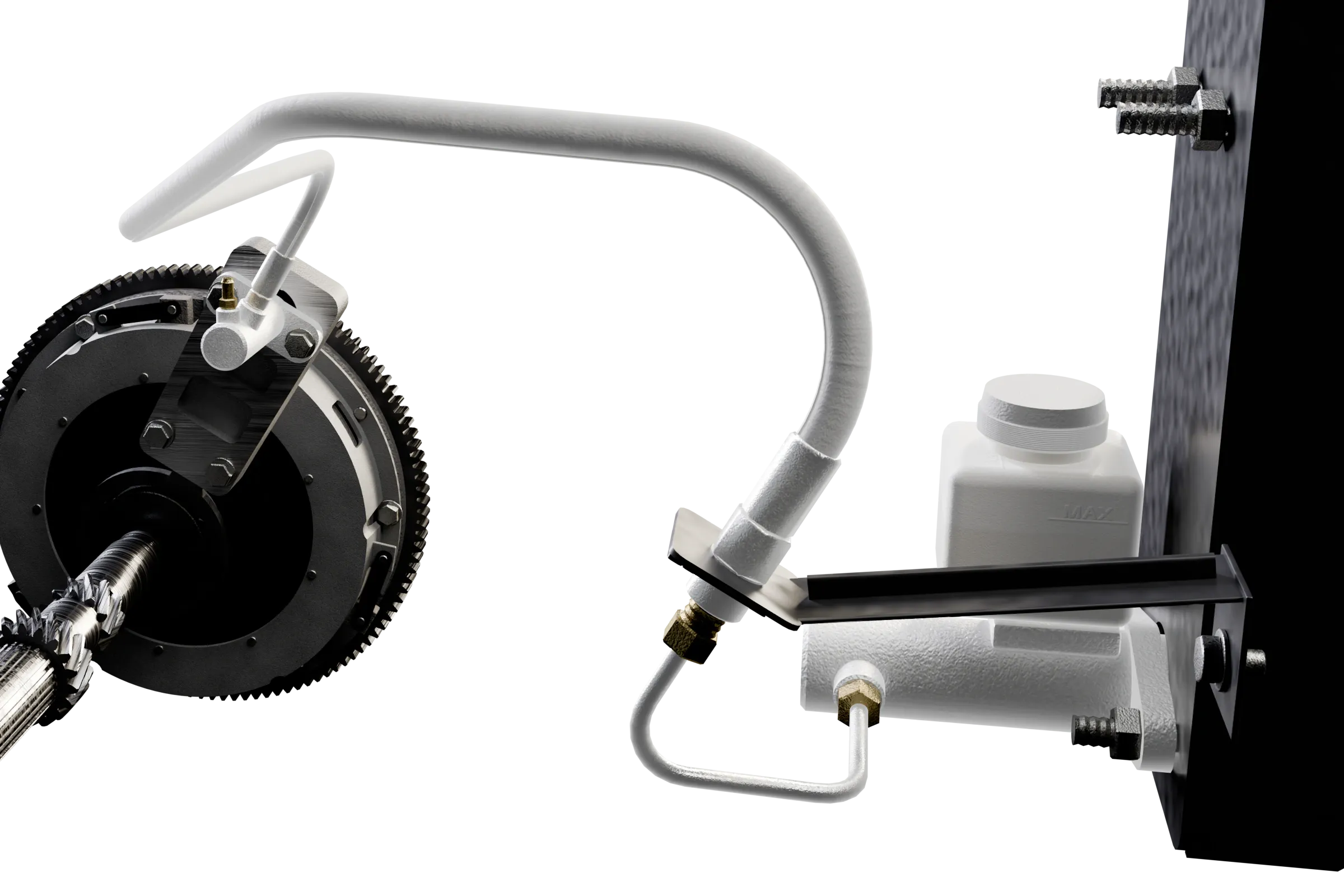
- Master cylinder
- Fluid reservoir
- Clutch line UK: Clutch pipe
- Clutch hose
- Slave cylinder
The likely causes, most common first
-
Air in the clutch hydraulics
Most likelyHow it shows A soft pedal that firms up when you pump it, often after the clutch or the brakes were worked on, since many cars share one fluid reservoir.
Check Bleeding the clutch at the slave cylinder's bleed screw removes the air. If the pedal goes soft again within days, air is getting in somewhere.
The fix A bleed with fresh fluid of the type shown on the reservoir cap.
Have it checked soon
-
A leaking slave cylinder
CommonHow it shows A pedal that gets softer over days or weeks, a falling reservoir level and, later, gears that grind going in.
Check Look for wet fluid at the slave cylinder on the transmission. On many cars it sits inside the bell housing around the input shaft, so a leak shows as fluid at the seam between the engine and the transmission.
The fix A new slave cylinder, then a bleed. One inside the bell housing means taking the transmission out, so the clutch is often renewed at the same time.
Have it checked soon
-
Worn master cylinder seals
CommonHow it shows A pedal that slowly sinks under steady pressure, or one that is soft only when warm, with no fluid lost.
Check With the engine off, hold the pedal halfway down for half a minute. A pedal that creeps toward the floor points to fluid getting past the master cylinder's seals. Look under the dash too: a leaking master cylinder drips onto the carpet.
The fix A new master cylinder, then a bleed.
Have it checked soon
-
A swelling or cracked clutch hose
Less likelyHow it shows A soft, long pedal even after a good bleed, sometimes with a damp patch along the hose.
Check Have a helper press the pedal while you watch the flexible hose near the transmission: one that bulges or weeps needs replacing.
The fix A new hose, then a bleed.
Have it checked soon
-
Old fluid that has absorbed water
Less likelyHow it shows A pedal that goes soft after a long hot drive or heavy traffic and firms up again once things cool.
Check Find out when the fluid was last changed. The clutch usually runs on brake fluid, which takes in water over the years.
The fix A full fluid change, flushing the old fluid out through the bleed screw.
Have it checked soon
How to narrow it down
- Look at the fluid reservoir on the firewall (bulkhead), often shared with the brakes. A level below MIN means fluid is going somewhere.
- With the engine off, press the clutch pedal slowly. It should feel even all the way down and come back up by itself.
- Pump the pedal a few times quickly. A pedal that firms up as you pump points to air.
- Hold the pedal halfway down for half a minute. A pedal that creeps toward the floor with no leak in sight points to the master cylinder.
- Look for wet fluid under the dash below the pedal, along the clutch line and hose, and at the seam between the engine and the transmission.
Is it safe to drive with a spongy clutch pedal?
Have it checked before you drive far
For a short trip, usually, but have it checked before you drive far. A spongy pedal can stop releasing the clutch fully, so gears grind or will not go in, and the leak behind it can let the pedal sink to the floor without warning. If the pedal stays down, stop somewhere safe: without the clutch you cannot shift.
Is a spongy clutch pedal different from a heavy one?
Yes, and they point to different parts. A spongy pedal is soft and springy, sometimes long, and usually firms up when you pump it: something in the hydraulics is compressing or leaking. A heavy pedal takes a hard push and feels the same every time. On a hydraulic clutch that usually means a binding pedal pivot, a sticking slave cylinder piston or a worn pressure plate whose diaphragm spring fingers need more force. On a cable clutch, a fraying or dry cable. A pedal that is both heavy and slow to come back up is usually the hydraulics as well.
Questions people ask
Why is my clutch pedal still soft after bleeding?
Usually because air is still in the system. Clutches are harder to bleed than brakes, because the slave cylinder often sits at an angle, or inside the bell housing, where a bubble can hide. Bleeding again, sometimes with a pressure bleeder, usually gets it out. A pedal that goes soft again within days points to a leak or a worn master cylinder.
Does a clutch use brake fluid?
On most cars, yes: the clutch hydraulics run on brake fluid, often from the same reservoir as the brakes. The reservoir cap or the owner's manual gives the type, usually DOT 3 or DOT 4. Use only the type it names.
Can a bad throwout bearing make the clutch pedal spongy?
Not usually. A worn throwout bearing (release bearing) makes a whir or chirp as you press the pedal, but the pedal itself feels the same. A soft or spongy feel is almost always hydraulic: air, a leak or worn seals.
Related
The parts
- What does a clutch slave cylinder do? A clutch slave cylinder is the small hydraulic cylinder on the transmission that releases the clutch.
- What does a clutch master cylinder do? A clutch master cylinder turns the push of the pedal into fluid pressure.
- What does brake fluid do? Brake fluid carries the push from the brake pedal to the calipers.
Similar symptoms
- Why does my clutch engage so high? A clutch that engages high, gripping only near the top of the pedal, usually has a worn clutch disc, above all if it also slips in high gears.
- Why does my transmission grind when I shift? A manual transmission grinds when the gear you select is still turning at a different speed from the shaft it locks to.
- What causes a spongy brake pedal? A spongy or soft brake pedal usually means air in the brake fluid, which compresses where fluid does not.
- Why won't my manual car go into gear? When a manual car won't go into gear, the usual cause is a clutch that isn't fully releasing, so the input shaft keeps turning and the synchros can't line the gear up.
