
What does a timing chain do?
A timing chain links the crankshaft to the camshafts, so the valves open and close in step with the pistons. The drive is geared two to one, so the camshafts turn at half the crankshaft's speed. A stretched chain, or a weak tensioner, rattles for a few seconds after a cold start.
Also called cam chain
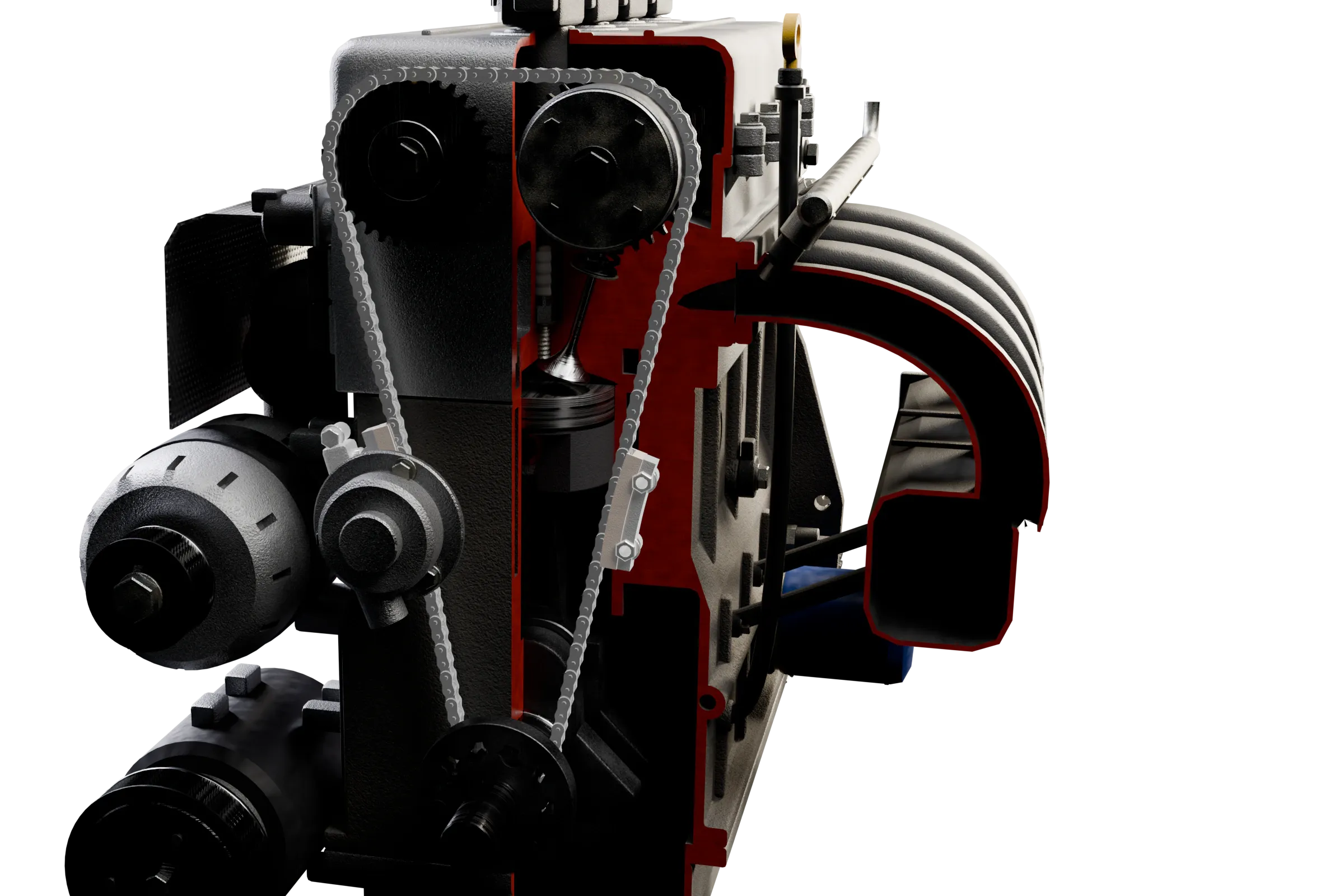
- Timing chain
- Hydraulic chain tensioner
- Exhaust cam sprocket
- Intake cam phaser + sprocket
- Crankshaft sprocket
How does a timing chain work?
In the app's engine a 126-link roller chain runs from a 17-tooth sprocket on the crankshaft round two 34-tooth sprockets, one on each camshaft. With twice the teeth, each camshaft turns once for every two turns of the crankshaft, so each valve opens once per four-stroke cycle, always at the same point in the piston's travel.
The chain has to stay taut for the timing to stay exact. A fixed guide steadies its tight side, and a pivoting arm presses on the slack side, pushed by a hydraulic tensioner that the model loads with a spring and engine oil pressure, with a ratchet to stop it backing off as the chain wears.
Unlike a cambelt, the chain runs in the engine's oil behind the timing cover, and on most engines it is meant to last the life of the engine, with no replacement interval.
What are the symptoms of a stretched timing chain?
- A rattle for a few seconds after a cold start. Until the oil pressure builds, a worn tensioner cannot hold the slack and the chain slaps its guides; the rattle fades as the pressure rises.
- A rattle that stays once the engine is warm. Once the tensioner has run out of travel, the slack stays, and the chain rattles at idle or under light load.
- The engine warning light. Many engines compare their camshaft and crankshaft sensors, and log a timing fault as a stretched chain lets the camshafts fall behind.
- Rough running and lost power. Late valve timing makes the engine run less cleanly and pull less well, especially at low revs.
- Pieces of guide in the oil. Bits of plastic from a worn chain guide in the sump or the oil filter mean the chain has been slapping the guides.
What happens if a timing chain breaks?
Have it checked before you drive far
The engine stops at once, and on many engines the damage does not end there. With the camshafts no longer turning, some valves are left open as the pistons keep rising, and on an interference engine the pistons hit them: bent valves at least, and sometimes damaged pistons and a damaged cylinder head. A chain that jumps a tooth can do the same, so a timing chain rattle is one to have checked before you drive far, not one to live with.
Why does a timing chain stretch?
It does not stretch the way a rubber band does. Each link turns on pins and bushes as it bends round the sprockets, many millions of times over the years, and those surfaces wear: a few hundredths of a millimetre at each joint, over 126 links, makes a chain several millimetres longer. The tensioner takes up the extra length until it runs out of travel, while the camshafts fall a little further behind the crankshaft.
How is a stretched timing chain checked?
By listening at a cold start, then by reading what the engine computer knows: some engines report how far the camshafts have drifted against the crankshaft, and the maker gives a limit. On others the tensioner’s extension is measured, or the chain is checked with the cover off. The four-stroke engine guide shows the valve timing the chain has to hold.
What does replacing a timing chain involve?
- On many engines, as in the app's, the timing cover also carries the water pump, the oil pump and the front crankshaft seal, so the oil and coolant are drained first and the parts in front of the cover come off: the auxiliary belt, the crankshaft pulley and often an engine mount.
- Turn the engine to top dead centre on cylinder 1 and lock the crankshaft and camshafts with the engine's timing tools, so nothing can move while the chain is off.
- Take off the timing cover, release the tensioner and lift out the chain with its guides and tensioner arm.
- Fit the new chain, guides and tensioner as a kit, with the chain's coloured links on the sprockets' marks, then release the tensioner onto the chain.
- Take the locking tools out and turn the engine two full turns by hand: it should turn freely, and the tools should go back in without force.
- Refit the cover with new seals, refill the oil and coolant and run the engine, listening for the cold-start rattle to be gone.
Tighten every nut and bolt to the figure in the maker's manual for your car.
Demanding work on most engines, often most of a day, and best left to someone with the engine's own timing tools: an error of a single tooth can bend valves. The chain, guides and tensioner are replaced together, and often the sprockets too.
Questions people ask
Does a timing chain need replacing at a set mileage?
Not on most engines. The maker gives no interval and expects the chain to last the life of the engine. It is replaced when it shows signs of stretch, such as a rattle at start-up or a timing fault, which on some engines comes well before the car is old.
Can a stretched timing chain put the engine warning light on?
Yes, on many engines. The engine computer watches the camshaft and crankshaft sensors, and when a stretched chain lets the camshafts fall behind by more than it allows, it logs a fault and lights the warning lamp, sometimes before any rattle.
Can the wrong oil wear out a timing chain?
It can speed the wear up. The chain's pins and bushes rely on clean oil of the right grade, so long service intervals, the wrong specification and sooty oil all wear them faster. Changing the oil on time, with the oil the maker specifies, does a chain the most good.
Is a timing chain replaced on its own?
Rarely. The guides wear with the chain and the tensioner may be at the end of its travel, so a timing chain kit brings the chain, guides and tensioner, often with new sprockets, and all of it goes in together.
Related
Parts nearby
- What do spark plugs do? Spark plugs light the compressed fuel and air in each cylinder of a petrol engine.
Explained
- Timing chain vs cambelt: what's the difference? Both a cambelt and a timing chain keep the camshafts in step with the crankshaft.
The whole system
- How does a four-stroke engine work? The four-stroke engine, part by part, with an interactive diagram.
