
Timing chain vs cambelt: what's the difference?
Both a cambelt and a timing chain keep the camshafts in step with the crankshaft. A cambelt, called a timing belt in the US, is a toothed rubber belt replaced on a schedule. A timing chain is a metal roller chain that runs in oil and usually lasts the life of the engine, though it can stretch.
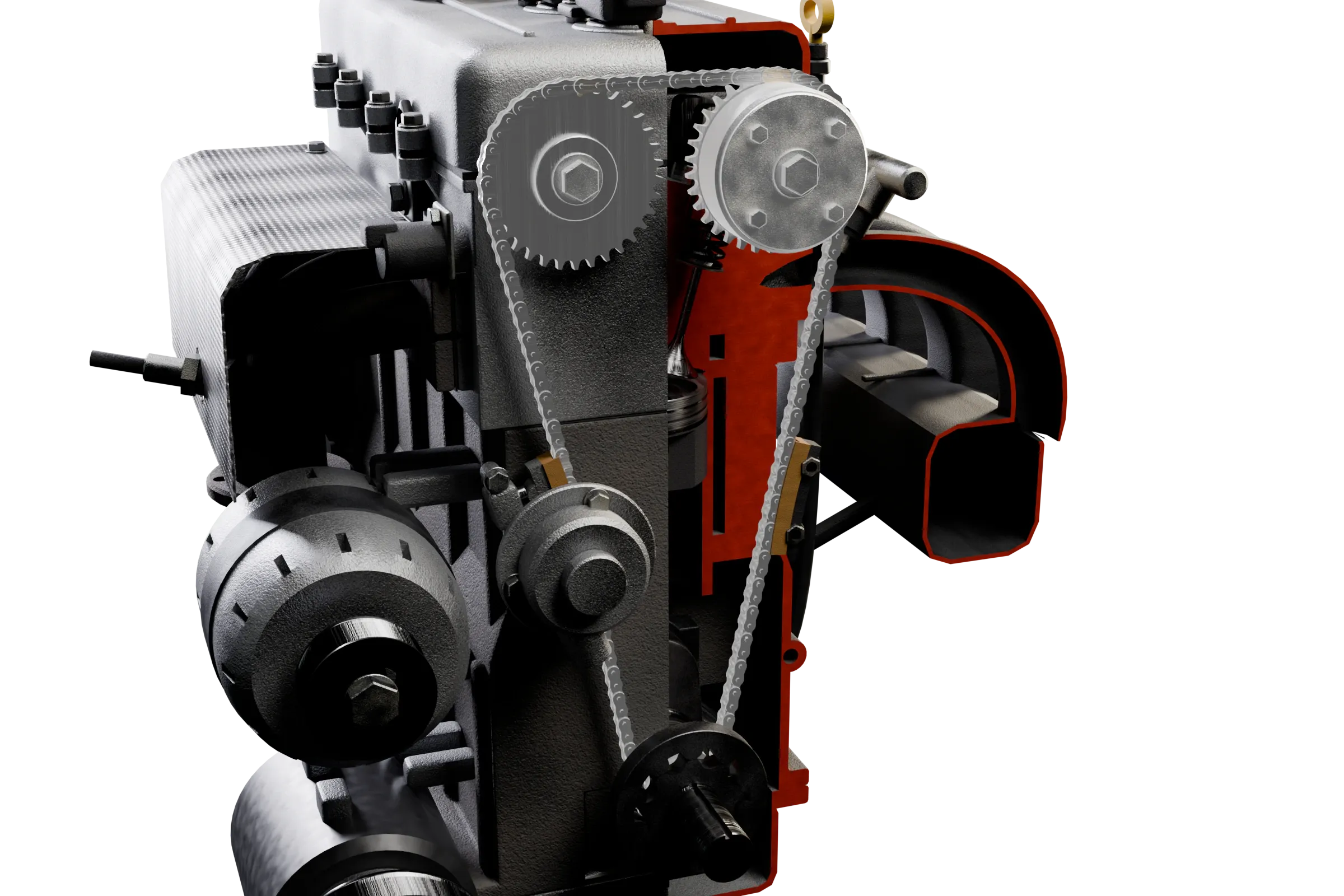
- Timing chain
- Exhaust cam sprocket
- Crankshaft sprocket
At a glance
| Timing chain | Cambelt (timing belt) | |
|---|---|---|
| Made of | Steel links and rollers, like a bicycle chain | Rubber with moulded teeth, reinforced with glass-fibre cords |
| Where it runs | Inside the engine, in its oil | Behind a plastic cover on the end of the engine, dry on most engines |
| When it is replaced | When it wears: there is no set interval on most engines | On a schedule, by age or mileage, whichever comes first |
| How it wears | It stretches as its pins and bushes wear, and its guides and tensioner wear with it | The rubber hardens and cracks with age, and oil or coolant leaks weaken it |
| Warning before it fails | Usually: a rattle at start-up, then an engine warning light | Often none |
| Usually renewed with it | The tensioner and guides | The tensioner, the idler pulleys and often the water pump |
Why does an engine need a chain or belt at all?
To open each valve at the right moment. A four-stroke cycle takes two turns of the crankshaft and each valve opens once per cycle, so the camshafts have to turn at exactly half crank speed, in step, for the life of the engine. In the app’s four-stroke engine, a 126-link roller chain runs from a 17-tooth sprocket on the crankshaft to 34-tooth sprockets on the two camshafts, twice as many teeth. A hydraulic tensioner presses a nylon-faced arm onto the slack side of the chain, and a fixed guide stops the tight side whipping.
A cambelt does the same with teeth moulded into its inner face, running on toothed pulleys. Neither may slip: if the drive jumps even one tooth, the valve timing is out and the engine runs badly, or not at all.
How often does a cambelt need changing?
At the interval in the car’s service schedule, which is set by age as well as by mileage: usually every 4 to 10 years, or sooner if the car reaches the mileage first. Age matters because the rubber hardens and cracks with time, so a car that does few miles still needs its belt changed on time. Intervals vary widely between engines, so check the schedule for your car. On a used car with no record of a belt change, treat it as due.
The tensioner and idler pulleys are usually changed with the belt, and so is the water pump where the belt drives it. Some recent engines use a belt that runs in the engine oil, a wet belt, which has its own interval and depends on the right oil.
What happens if a cambelt snaps?
The engine stops at once, because the camshafts stop while the crankshaft keeps turning. In an interference engine, a fully open valve reaches into the space the piston moves through, so valves left open by the stopped camshafts are hit by the rising pistons. That bends valves and can damage the pistons and the cylinder head. Most modern engines are interference designs, and diesels almost always are. In a free-running engine there is room for both, and a new belt is often all it needs.
Does a timing chain ever need replacing?
Not as routine on most engines, but chains do wear. The pins and bushes between the links wear, the chain grows longer, which is called stretch, and the tensioner takes up the slack until it runs out of travel. Long gaps between oil changes, or the wrong oil, speed this up.
The usual first sign is a rattle for a few seconds after a cold start, before oil pressure has pumped the tensioner up. Later the timing drifts far enough for the engine computer to notice and turn on the engine warning light. What a timing chain does covers the signs in more detail.
Questions people ask
Is a cambelt the same as a timing belt?
Yes. Cambelt is the usual name in the UK and timing belt the usual one in the US, and makers' manuals use either.
Does an engine with a timing chain still have a fan belt?
Usually, yes. The fan belt, or auxiliary belt, is a different part: a ribbed belt outside the engine that drives the accessories. The app's engine has both, a timing chain inside and one ribbed belt outside that drives the alternator, the water pump and the air conditioning compressor.
How can you tell if a car has a cambelt or a timing chain?
The service schedule is the surest guide: an engine with a cambelt has a belt change listed in it. A belt usually sits behind a plastic cover on the end of the engine, while a chain is hidden inside a metal cover.
Is a timing chain better than a timing belt?
Neither is better in every way. A chain usually lasts the life of the engine and gives warning before it fails; a belt is quieter and lighter, but it has to be changed on time, because it can break without warning.
Related
The parts
- What does a timing chain do? A timing chain links the crankshaft to the camshafts, so the valves open and close in step with the pistons.
