
What does a head gasket do?
A head gasket seals the joint between the cylinder head and the engine block. It holds in the pressure of combustion and keeps the coolant and oil in their own passages. A blown head gasket lets them mix or escape: white exhaust smoke, overheating, coolant loss and a milky residue under the oil cap.
Also called cylinder head gasket
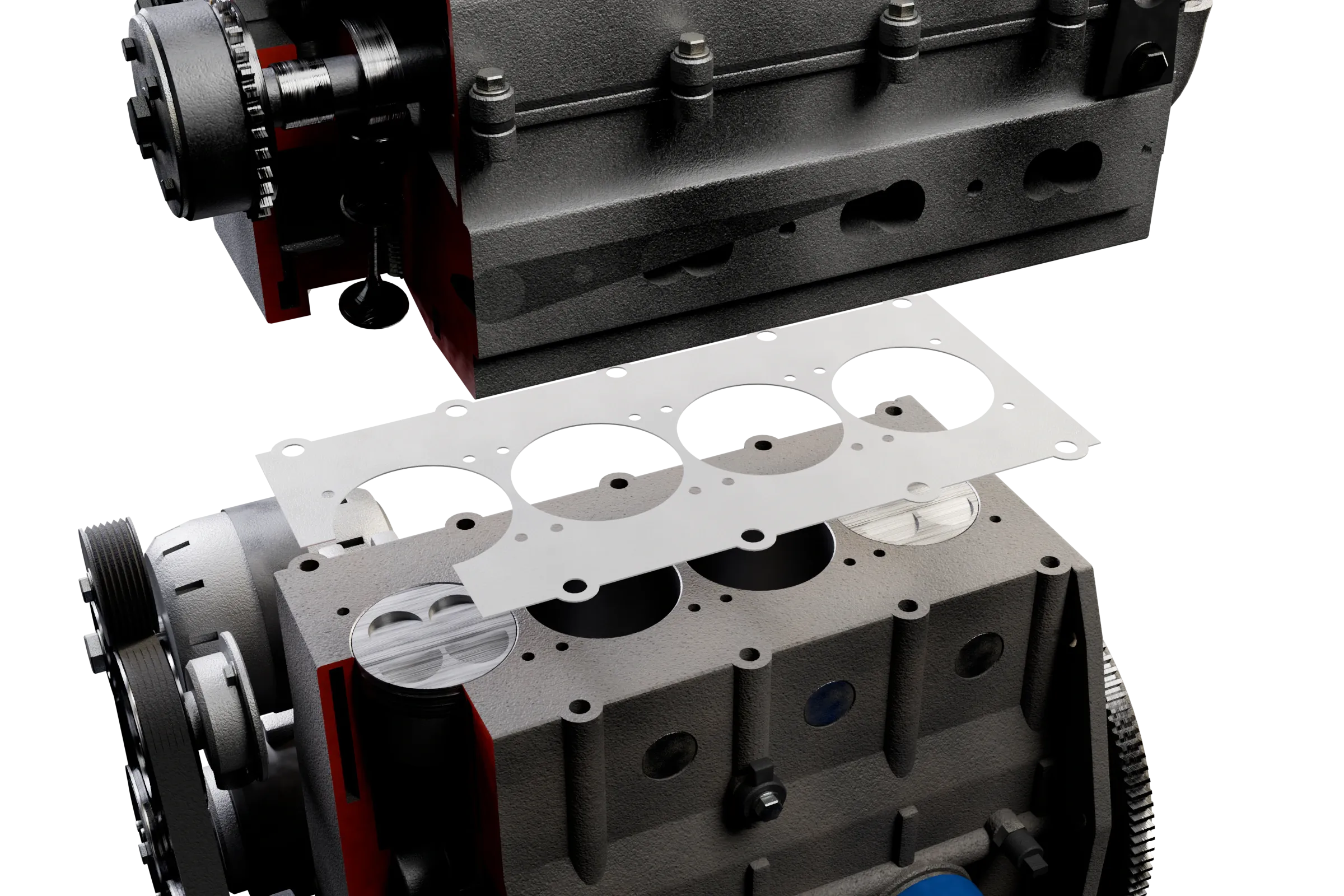
- Head gasket
- Cylinder head
- Cylinder block
How does a head gasket work?
The cylinder head sits on top of the block and closes off the cylinders, and both are cast with passages that carry coolant and oil from one to the other. The gasket fills the joint between them. In the app's engine it is a multi-layer steel gasket: thin embossed steel layers that the head bolts clamp flat, with a raised fire ring around each bore to hold in combustion pressure and sealed openings for every coolant and oil passage.
It works hard. Every power stroke pushes burning gas against the fire rings, the aluminum head and the block grow by different amounts as they heat up, and the cooling side runs under pressure. The head bolts keep the clamp even across the whole joint, which is why they are tightened in a set order and, on many engines, replaced whenever the head comes off.
Most head gaskets fail after the engine has overheated. The heat can warp the head so that it no longer clamps the gasket evenly, and a fire ring or the seal between two passages gives way. Severe knock and head bolts that have lost their clamp can do the same.
What are the symptoms of a blown head gasket?
- White smoke from the exhaust. Thick white smoke with a sweet smell that stays after the engine has warmed up is coolant burning in a cylinder. What does white smoke from the exhaust mean?
- Overheating. Combustion gas forced into the cooling system pushes coolant out and leaves pockets of gas, so the temperature gauge climbs, often on a long hill or in traffic. Why is my car overheating?
- Coolant that keeps disappearing. The reservoir needs topping up again and again, yet nothing drips under the car: the coolant is being burned or pushed out.
- A milky residue under the oil cap. Coolant mixing with the oil turns it into a light brown sludge on the cap and the dipstick. Short trips in cold weather can leave a little condensation under the cap too, so check the dipstick as well.
- Bubbles in the coolant reservoir. Streams of bubbles rising through the coolant with the engine running mean combustion gas is getting into the cooling system.
- Rough running on two cylinders. A gasket that fails between two neighboring cylinders lets them leak into each other, so both lose compression, the engine runs rough and the check engine light may come on.
Can you drive with a blown head gasket?
Don't drive it
No. Every drive makes it worse: the engine loses coolant and overheats, the heat can warp or crack the cylinder head, and coolant in the oil wears out the bearings. Coolant that fills a cylinder can even stop the engine from turning. If the signs point to a blown head gasket, park the car and have it towed to a repair shop, and if the temperature gauge climbs while you are driving, pull over when it is safe and switch off.
Where is the head gasket located?
Between the cylinder head and the engine block, the two biggest parts of the engine. Only its edge shows, as a thin line of steel along the joint under the intake and exhaust manifolds. To reach the gasket itself, the head has to come off, and on most engines that means removing the timing drive, the manifolds and most of what sits on top of the engine first. The four-stroke engine guide shows where it sits in an exploded diagram of the whole engine.
How do you test for a blown head gasket?
A repair shop usually starts with two tests. A combustion leak test, often called a block test, draws air from the top of the cooling system through a blue test fluid that turns yellow when exhaust gas is in it. A cooling system pressure test pumps the system up to its working pressure with the engine off and watches the gauge: a slow fall with no outside leak means the coolant is going somewhere inside the engine.
A compression or leak-down test then shows which cylinders are affected. Two cylinders side by side with low compression, and air from one escaping into the other, point to the gasket between them.
What does replacing a head gasket involve?
- Drain the coolant and the oil, and disconnect the battery.
- Remove everything fastened to the head: the intake and exhaust manifolds, the ignition coils, the valve cover and the timing drive, with the engine locked at top dead center by its timing tools.
- Undo the head bolts in the reverse of their tightening order and lift the head off the block.
- Clean both faces and check the head and the block for flatness and cracks. A warped head is machined flat or replaced.
- Lay the new gasket over the dowels the right way up, set the head down and tighten the head bolts in their sequence, using new bolts where the automaker calls for them.
- Reinstall the timing drive and everything else, refill the oil and coolant, bleed the air out of the cooling system, then run the engine up to temperature and check for leaks.
Tighten every nut and bolt to the torque spec in the manufacturer's service manual for your car.
Long, skilled work, often a day or more in a shop, because so much of the engine comes apart first. The head is checked for warping and cracks while it is off, and after a bad overheat a replacement engine can make more sense.
Questions people ask
Can a head gasket sealer fix a blown head gasket?
Sometimes, for a while, on a small leak. Sealers travel with the coolant and harden where they find an escape, but they cannot rebuild a burned fire ring, flatten a warped head or seal a leak between two cylinders, and they can clog narrow passages in the radiator and the heater core.
Is a blown head gasket the same as a cracked cylinder head?
No, but they show the same signs and often come together, because the overheating that blows a gasket can also crack or warp the head. Only taking the head off, or pressure testing it on its own, tells them apart for certain.
How long does a head gasket last?
Usually the life of the engine. Head gaskets rarely wear out on their own. They fail after the engine overheats, after severe knock, or on a few engines with a known weakness, so most cars never need one.
Can a head gasket leak oil on the outside of the engine?
Yes. An outside oil leak shows as a wet line along the joint between the head and the block. It is less urgent than coolant getting into the cylinders, but it still means the gasket is failing, and many leaks that look like the head gasket turn out to come from the valve cover gasket above it.
Related
Symptoms
- What does white smoke from the exhaust mean? Thin white vapor from the exhaust on a cold morning is water condensing, and it clears as the engine warms.
- Why is my car overheating? A car usually overheats because it is low on coolant from a leak, or because the coolant is not getting through: a thermostat stuck closed, a failing water pump, a broken belt or a radiator fan that does not run.
Parts nearby
- What does a water pump do in a car? A car's water pump circulates coolant through the engine block, the cylinder head and the radiator, carrying heat out of the engine.
- What does a thermostat do in a car? A car's thermostat is a valve in the cooling system that keeps the coolant inside the engine until it is warm, then opens to send it through the radiator.
- What do piston rings do? Piston rings are the split metal rings in grooves around each piston.
- What do spark plugs do? Spark plugs light the compressed fuel and air in each cylinder of a gasoline engine.
The whole system
- How does a four-stroke engine work? The four-stroke engine, part by part, with an interactive diagram.
