
What does a thermostat do in a car?
A car's thermostat is a valve in the cooling system that keeps the coolant inside the engine until it is warm, then opens to send it through the radiator. It lets the engine warm up quickly and then holds it at its working temperature. A bad thermostat sticks open, so the engine runs cold, or sticks closed, so it overheats.
Also called engine thermostat, coolant thermostat
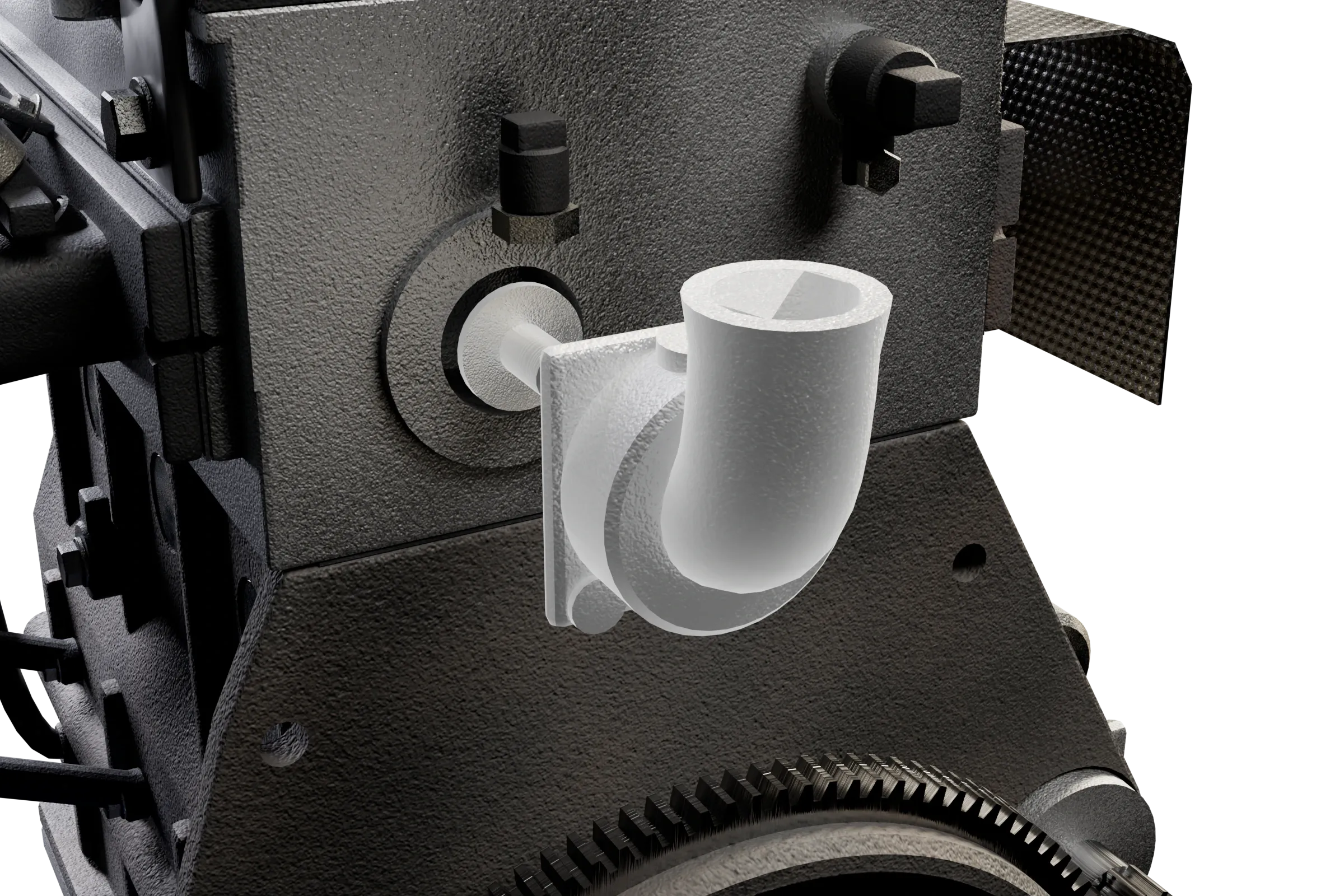
- Thermostat
- Thermostat housing / coolant outlet
- Cylinder head
How does a car thermostat work?
It is a wax-pellet valve. A small copper cup of wax sits in the coolant, and as the wax warms it melts and swells, pushing a pin that lifts the valve off its seat against a spring. In the app's engine the thermostat sits in its housing on the cylinder head, where the top radiator hose connects, and it starts to open at about 190 °F (88 °C). As the coolant cools again the wax shrinks and the spring closes the valve.
While it is shut, the water pump still circulates coolant around the engine and through the heater, but none of it goes to the radiator, so the engine reaches its working temperature in minutes rather than miles. Once it opens, the thermostat keeps adjusting how far it is open, so the engine stays near the same temperature whether the car is idling in traffic or climbing a hill in summer.
Many newer engines use a thermostat with a small heater built into the wax element, so the engine computer can open it a little early under heavy load. It works the same way, with a wire connector added.
What are the symptoms of a bad thermostat?
- The temperature gauge climbs toward hot. A thermostat stuck closed keeps the hot coolant out of the radiator, so the engine overheats, often within a few minutes of driving. Why is my car overheating?
- The gauge stays low or takes ages to rise. A thermostat stuck open sends coolant through the radiator from the start, so the engine warms slowly, most of all on the highway in cold weather.
- A heater that blows lukewarm air. The heater runs on engine coolant, so an engine that never fully warms up gives a weak heater in winter.
- The check engine light. Many engines log a fault when the coolant takes too long to reach its working temperature, which is the usual code for a thermostat stuck open.
- Worse gas mileage. A cold engine runs a richer mixture, so it uses more fuel than it should.
- Coolant around the thermostat housing. A leak or crusted coolant at the housing on the engine points to its gasket or to a cracked plastic housing.
Can you drive with a bad thermostat?
Have it checked before you drive far
Not far, and not at all if the temperature gauge climbs. A thermostat stuck open only makes the engine slow to warm up: the heater is weak, gas mileage drops and the check engine light may come on, so have it replaced soon. One stuck closed traps the coolant in the engine, which can overheat within minutes. If the gauge rises toward hot, pull over when it is safe, switch the engine off and let it cool, and never open the radiator or reservoir cap while it is hot.
Why do thermostats fail?
Age and the state of the coolant. The wax element works well for years, but the spring weakens, and old coolant that has lost its corrosion protection leaves scale on the valve and its seat, until the valve no longer closes fully or no longer opens. Most thermostats fail stuck open, which is the safer way round. A thermostat that has stuck closed is less common and far more serious, and an engine that has overheated because of one needs its head gasket and cooling system checked as well.
Should you replace the thermostat with the coolant?
It is common practice, and worth it on an older car. If the cooling system is being drained anyway, for a coolant flush, a water pump or a hose, the thermostat is easy to reach and quick to change while the system is empty. Use the thermostat the automaker specifies: one that opens at a lower temperature does not cool the engine better, it only makes it run below the temperature it was designed for. The four-stroke engine guide shows how the cooling side fits around the cylinders.
What does replacing a thermostat involve?
- Let the engine cool completely, then drain enough coolant to bring the level below the thermostat housing.
- Disconnect the radiator hose from the housing, and the sensor or heater connector if it has one.
- Unbolt the housing and lift out the old thermostat, noting which way round it sits and where its small air bleed hole points.
- Clean the sealing faces and install the new thermostat with a new gasket or O-ring, the right way round.
- Bolt the housing back on, reconnect the hose, refill with the coolant the automaker specifies and bleed the air out of the system.
- Run the engine up to temperature, watch the gauge settle where it normally sits and check the housing for leaks.
Tighten every nut and bolt to the torque spec in the manufacturer's service manual for your car.
On many four-cylinder engines this is a short repair, but on some the thermostat sits deep under the intake manifold or comes built into a housing that has to be replaced as one part.
Questions people ask
What is the difference between a thermostat stuck open and stuck closed?
Stuck open, the coolant goes through the radiator all the time, so the engine runs cool: a weak heater, poor gas mileage and a check engine light, but no immediate danger. Stuck closed, the coolant cannot reach the radiator, so the engine overheats quickly, which can damage it within minutes.
Can you drive without a thermostat?
It is not a good idea. With no thermostat the engine runs cold, wears faster and uses more fuel, and on many engines the coolant takes the easiest path and skips parts of the engine. A thermostat is a small part, and it protects the whole engine.
How do you know if it is the thermostat or the water pump?
By how the problem shows. A thermostat stuck closed overheats the engine quickly while the upper radiator hose stays cool, because no hot coolant reaches it. A failing water pump usually leaks from its weep hole or makes a grinding noise first, and overheats more slowly.
Where is the thermostat located?
On most engines it sits where the upper radiator hose meets the engine, under a small metal or plastic housing, as in the app's engine. On some it sits at the lower hose instead, at the inlet to the water pump.
Related
Symptoms
- Why is my car overheating? A car usually overheats because it is low on coolant from a leak, or because the coolant is not getting through: a thermostat stuck closed, a failing water pump, a broken belt or a radiator fan that does not run.
Parts nearby
- What does a water pump do in a car? A car's water pump circulates coolant through the engine block, the cylinder head and the radiator, carrying heat out of the engine.
- What does a head gasket do? A head gasket seals the joint between the cylinder head and the engine block.
- What do piston rings do? Piston rings are the split metal rings in grooves around each piston.
- What do spark plugs do? Spark plugs light the compressed fuel and air in each cylinder of a gasoline engine.
The whole system
- How does a four-stroke engine work? The four-stroke engine, part by part, with an interactive diagram.
