
What do piston rings do?
Piston rings are the split metal rings in grooves around each piston. The top two seal the burning gas above the piston, and the bottom one scrapes oil off the cylinder wall so it never reaches the combustion chamber. Bad piston rings burn oil, giving blue exhaust smoke and a falling oil level, and let compression leak away.
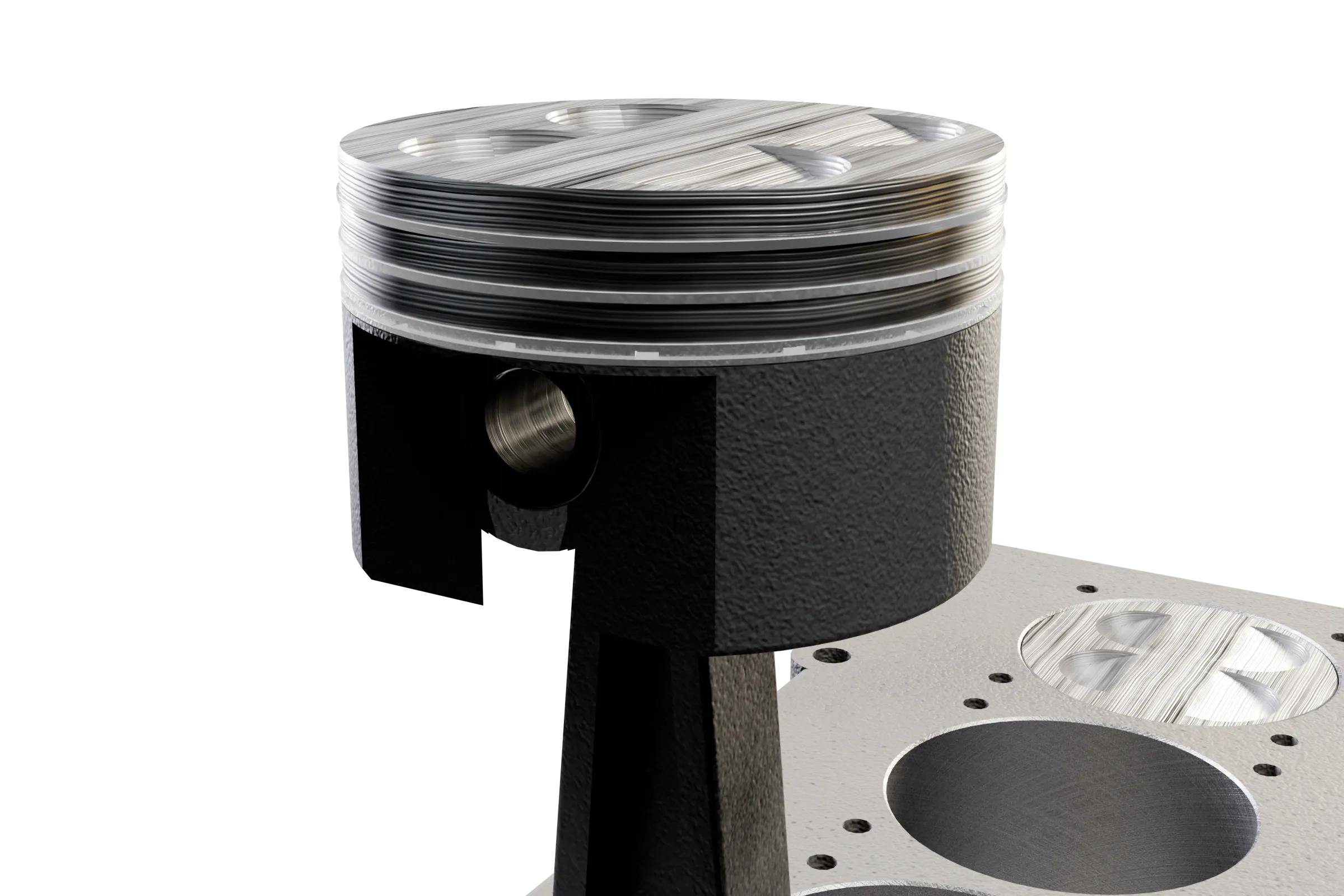
- Top compression ring
- Second compression ring
- Oil control ring
- Piston
How do piston rings work?
A piston is a little smaller than its cylinder, so it can slide freely as it heats up. The rings close the gap. Each is a split ring of cast iron or steel that springs outward against the cylinder wall, and on the power stroke the gas pressure gets behind the top ring and pushes it harder against the wall and down onto its groove, so it seals best when sealing matters most.
In the app's engine every piston carries three. The top compression ring takes the heat and the pressure. The second ring backs it up and, with its tapered face, scrapes oil down the wall. The oil control ring at the bottom has two thin rails and a spring expander between them: they wipe the oil the crankshaft flings up off the wall and drain it back through slots in the piston.
Their ends never quite meet. The end gap lets a ring expand as it heats without jamming against the wall, so the rings are set with their gaps spread around the piston, and a little gas always slips past. That leak, called blow-by, is pulled out of the crankcase by a breather and burned in the engine. Worn rings let far more of it through.
What are the symptoms of bad piston rings?
- Blue smoke from the exhaust. Oil burning in the cylinders shows as blue-gray smoke, worst when you accelerate hard after slowing down, or under load uphill. What does white smoke from the exhaust mean?
- The oil level falls between changes. An engine that needs topping up with no leak in sight is burning its oil. Some use is normal; the owner's manual says how much is too much.
- Lost power and low compression. Gas escaping past the rings means less push on the piston, so the engine feels flat, most of all at low speed.
- Oily spark plugs and misfires. Plugs that come out wet and black with oil, on one cylinder or all of them, point to rings or valve stem seals.
- Pressure at the oil fill cap. With the engine idling, a lot of blow-by pushes fumes out of the oil filler. A shop can measure it.
Can you drive with bad piston rings?
Have it checked before you drive far
Usually, for a while, if you keep the oil topped up and have the engine checked soon. Worn rings do not fail all at once: the engine burns more oil, loses some power and fouls its spark plugs over time. The risks are running low on oil, which can wreck the bearings, and oil reaching the catalytic converter, which can clog it. Check the oil level every few fill-ups, and if the red oil warning light comes on, stop the engine at once.
How do you test piston rings?
With two tests a repair shop runs on a warm engine. A compression test screws a gauge into each spark plug hole and cranks the engine: one cylinder much lower than the others is losing compression somewhere. Squirting a teaspoon of oil into that cylinder and testing again tells you where. If the reading jumps up, the oil has sealed the rings for a moment, so the rings are worn; if it barely moves, the leak is at a valve or the head gasket.
A leak-down test goes further. It fills each cylinder with compressed air at top dead center and listens for where the air comes out: from the oil filler for the rings, the exhaust or intake for a valve, the coolant for the head gasket.
Why do worn rings make blue smoke?
Because the oil control ring can no longer wipe the wall clean. Each time the piston goes down, a film of oil stays on the cylinder wall, and the burning mixture on the next power stroke burns some of it. A healthy engine burns a trace; worn rings leave enough to show as a blue haze from the tailpipe. The four-stroke engine guide shows the piston’s four strokes and the rings in the app’s engine.
What does replacing piston rings involve?
- Confirm the cause first with a compression test and a leak-down test, so the rings are not blamed for worn valve stem seals or valves.
- Drain the oil and coolant and take the engine apart down to the bottom end: the cylinder head, the oil pan and the oil pump pickup come off, and on many cars the engine comes out of the car.
- Undo each connecting rod's cap and push the piston and rod up and out of the top of its cylinder.
- Measure each cylinder for wear and taper. A worn bore is honed or bored oversize, which needs oversize pistons too.
- Fit the new rings with a ring expander, each the right way up and with its gap where the automaker says, then slide the pistons back in with a ring compressor.
- Reassemble the engine with new gaskets and bearings, refill it, and run it in gently as the ring maker advises so the rings bed in.
Tighten every nut and bolt to the torque spec in the manufacturer's service manual for your car.
Piston rings are replaced as part of an engine rebuild, not on their own, and a shop usually weighs the work against a replacement engine. The rings wear with the cylinders, so new rings in worn bores rarely last.
Questions people ask
Is it the piston rings or the valve stem seals?
When the blue smoke shows tells you. Worn valve stem seals let oil run down the valves while the engine sits, so it smokes for a moment after starting or after idling, then clears. Worn rings smoke most under load, when you accelerate hard, and fail a compression test.
Can an additive fix worn piston rings?
It can free rings that have stuck in their grooves with carbon, which sometimes cures oil burning on an engine that has sat or done many short trips. It cannot rebuild a ring or a cylinder that has worn, so a mechanical fault stays.
What causes piston rings to wear out?
Mostly time and dirt. Grit drawn in through a leaking air filter, oil changed too rarely, and running an engine hard before it warms up all wear the rings and the bores. Overheating can break a ring or melt the lands between the grooves.
Related
Symptoms
- What does white smoke from the exhaust mean? Thin white vapor from the exhaust on a cold morning is water condensing, and it clears as the engine warms.
Parts nearby
- What does a head gasket do? A head gasket seals the joint between the cylinder head and the engine block.
- What does an oil filter do? An oil filter cleans the engine oil on its way from the pump to the bearings, trapping soot, metal particles and grit in a pleated paper element.
- What do spark plugs do? Spark plugs light the compressed fuel and air in each cylinder of a gasoline engine.
- What does a camshaft do? A camshaft opens the engine's valves. It is a shaft with an egg-shaped lobe for each valve, turned by the timing chain or belt at half the crankshaft's speed, so each valve opens once per four-stroke cycle at exactly the right moment.
The whole system
- How does a four-stroke engine work? The four-stroke engine, part by part, with an interactive diagram.
