
What does a camshaft do?
A camshaft opens the engine's valves. It is a shaft with an egg-shaped lobe for each valve, turned by the timing chain or belt at half the crankshaft's speed, so each valve opens once per four-stroke cycle at exactly the right moment. A worn camshaft ticks, loses power and can turn on the check engine light.
Also called cam
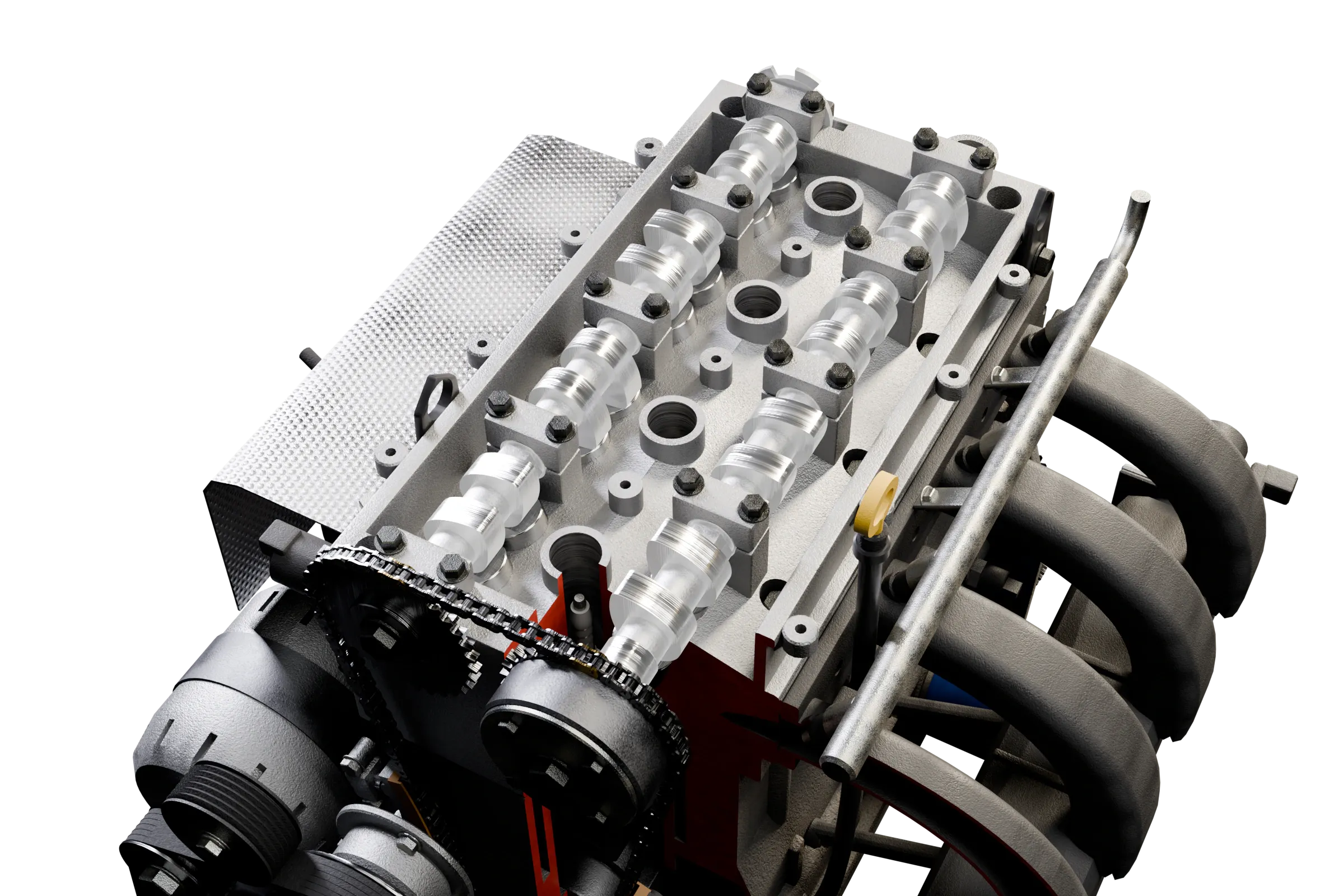
- Intake camshaft
- Exhaust camshaft
- Intake bucket lifter UK: Intake bucket tappet
- Intake cam phaser + sprocket
How does a camshaft work?
Each lobe is round for most of its turn, where its valve stays shut, with a raised nose on one side. As the nose comes round it pushes the valve open against its spring, holds it there for a moment and lets it close again. The lobe's shape sets how far the valve opens and for how long: in the app's engine each intake valve lifts up to 8.6 mm off its seat, and each exhaust valve 8.2 mm.
The app's engine has two overhead camshafts in the cylinder head, one for the intake valves and one for the exhaust valves, opening 16 valves in all, four per cylinder. Each lobe presses straight down on a bucket lifter over its valve, and the thickness of the bucket's crown sets the small clearance that lets the valve close fully when the engine is hot. The timing chain turns both camshafts at half the crankshaft's speed, because each valve opens once every two turns of the engine.
The intake camshaft also carries a cam phaser in place of a plain sprocket. Oil pressure, sent by a solenoid valve the engine computer controls, turns the camshaft a few degrees ahead of or behind its sprocket while the engine runs, so the valve timing can suit low speed and high speed.
What are the symptoms of a bad camshaft?
- A ticking or tapping from the top of the engine. A worn lobe or a clearance that has grown lets the bucket rattle on the cam, a tick that follows engine speed. Why is my engine ticking?
- Lost power and a misfire on one cylinder. A lobe worn flat opens its valve less, so that cylinder breathes poorly and may misfire, with the check engine light on.
- The check engine light with a timing code. The engine computer compares the camshaft and crankshaft sensors, and logs a fault when a cam phaser sticks or the timing drifts.
- Metal flakes in the oil. Glittering particles in the old oil or the filter can come from a lobe or bucket wearing away.
- Rough idle and backfiring. Valves that open late, early or not far enough upset the idle, and a valve that does not close fully can pop back into the intake.
Can you drive with a bad camshaft?
Have it checked before you drive far
Gently, for a short way, but have it checked before you drive far. A worn lobe usually gets worse slowly, but the metal it sheds travels with the oil and wears the bearings, and a camshaft that breaks or a cam phaser that jams can stop the engine. If the check engine light flashes, the misfire is bad enough to damage the catalytic converter: pull over when it is safe and switch off. If the red oil warning light comes on, stop the engine at once.
What wears out a camshaft?
Lack of oil, most of all. The lobes slide across their buckets under the full force of the valve springs, separated only by a film of oil, so oil that is old, thin or low lets them touch and scuff. Long oil change intervals, an engine that sits for months, and a bucket that stops turning, so it wears in one spot, all speed it up. Engines with flat-faced buckets, like the app’s, wear slowly when the oil is right. The valve clearance on such engines is set with buckets or shims of different thickness and should be measured at the interval the automaker gives.
What does the cam phaser do to the valve timing?
On most engines it holds the intake camshaft back at idle, so the intake and exhaust valves are open together only briefly and the idle stays smooth. At low and middle speeds under load it turns the camshaft ahead, closing the intake valves earlier for a stronger pull, and near the top of the rev range it turns it back again, so the valves close later and let in more of the fast-moving air. The four-stroke engine guide shows the valve timing degree by degree, and the app’s engine lets you watch each lobe press its bucket as the engine turns.
What does replacing a camshaft involve?
- Lock the engine at top dead center on cylinder 1 with its timing tools, so the crankshaft and camshafts stay in step.
- Remove the valve cover, the ignition coils and, where they are in the way, the front covers, then release the timing chain or belt from the cam sprockets.
- Undo the camshaft bearing caps in the order the automaker gives, a little at a time, so the camshaft comes down evenly against the valve springs.
- Lift the camshaft out and check the buckets under it and the bearing surfaces in the head for wear or scoring.
- Lubricate the new camshaft and its buckets with assembly lube, lay it in, and tighten the caps down in sequence.
- Refit the sprockets and the timing drive on their marks, measure the valve clearances, and turn the engine two full turns by hand before starting it.
Tighten every nut and bolt to the torque spec in the manufacturer's service manual for your car.
Skilled work that needs the engine's timing tools, because a camshaft set one tooth out can bend valves. The buckets or lifters that ran on a worn camshaft are usually replaced with it.
Questions people ask
What is a cam phaser?
A sprocket that can turn its camshaft a few degrees while the engine runs. Oil pressure, metered by a solenoid valve under the engine computer's control, fills chambers on either side of vanes inside it, advancing or retarding the camshaft to change the valve timing.
What is the difference between a camshaft and a crankshaft?
The crankshaft, at the bottom of the engine, turns the pistons' up-and-down motion into rotation and drives the car. The camshaft, at the top on most modern engines, is driven by the crankshaft at half its speed and opens the valves.
What is a camshaft position sensor?
A sensor that reads a toothed target on a camshaft so the engine computer knows which stroke each cylinder is on. In the app's engine it reads three teeth on the exhaust camshaft. It is a separate part from the camshaft, and it fails far more often.
Related
Symptoms
- Why is my engine ticking? An engine ticking noise, a light tapping that speeds up with the engine, most often comes from the valvetrain at the top of the engine: low oil, worn lifters or valve clearances out of adjustment.
Parts nearby
- What does a crankshaft position sensor do? A crankshaft position sensor reads a toothed ring on the crankshaft and tells the engine computer how fast the engine is turning and exactly where each piston is.
- What does a timing chain do? A timing chain links the crankshaft to the camshafts, so the valves open and close in step with the pistons.
- What do piston rings do? Piston rings are the split metal rings in grooves around each piston.
- What do spark plugs do? Spark plugs light the compressed fuel and air in each cylinder of a gasoline engine.
The whole system
- How does a four-stroke engine work? The four-stroke engine, part by part, with an interactive diagram.
