
What does a water pump do in a car?
A car's water pump circulates coolant through the engine block, the cylinder head and the radiator, carrying heat out of the engine. It is a belt- or chain-driven spinning impeller. A bad water pump leaks coolant from a small weep hole, whines or grinds as its bearing wears, and in the end lets the engine overheat.
Also called coolant pump
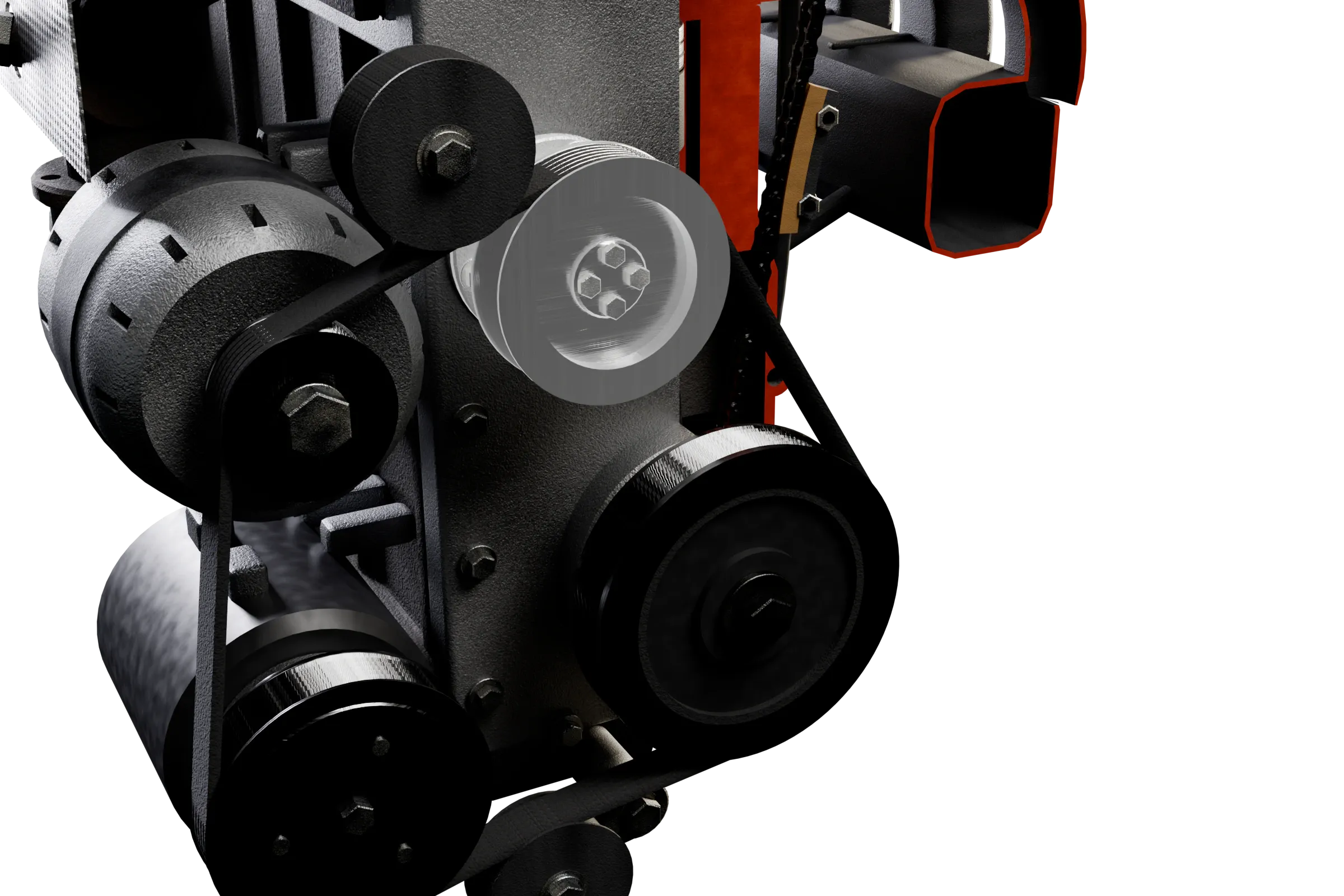
- Water pump
- Water pump pulley
- Serpentine belt UK: Accessory belt
- Harmonic balancer UK: Crankshaft pulley / torsional damper
How does a water pump work?
It is a centrifugal pump. A shaft turns an impeller with curved vanes inside a housing bolted to the engine; coolant comes in at the center and the spinning vanes fling it outward into the passages around the cylinders and up through the cylinder head. From there it goes back to the pump through the heater, or through the radiator once the thermostat opens.
In the app's engine the pump is driven from the crankshaft by the serpentine belt, which also turns the alternator and the A/C compressor. It turns faster than the crankshaft by the ratio of the two pulleys, so the flow rises and falls with engine speed. On many other engines the timing belt or chain drives it from behind the timing cover, and a few newer engines use an electric pump.
Two parts wear: the sealed bearing that carries the shaft, and the seal that keeps the coolant from following the shaft out of the housing. Between them sits a small weep hole, which lets a failing seal drip to the outside instead of washing coolant into the bearing.
What are the symptoms of a bad water pump?
- Coolant leaking from the front of the engine. Drips under the front of the car, or a crust of dried coolant around the pump's weep hole, mean its seal is going.
- A whine or grinding noise from the belt area. A worn bearing whines, rising with engine speed, then grinds as it gets worse.
- A wobbling pulley. With the engine off, a pump pulley that rocks when you try to move it has a worn bearing, and the belt may squeal or wear unevenly.
- The engine overheats. A pump with a corroded or broken impeller, or a seized bearing that throws the belt, no longer moves enough coolant. Why is my car overheating?
- Steam from the engine compartment. Coolant leaking onto hot engine parts steams, and a sweet smell often comes with it.
Can you drive with a bad water pump?
Don't drive it
Not safely. A pump that only weeps a little still needs replacing soon, but one that leaks steadily, grinds or wobbles can fail completely without warning. When it does, the coolant stops moving and the engine overheats within minutes, which can warp the cylinder head and blow the head gasket. Have it towed to a repair shop rather than driven, and if the temperature gauge climbs while you are driving, pull over when it is safe and switch off.
Where is the water pump located?
On the front of the engine on most cars, low down where the coolant hoses from the radiator come in. In the app’s engine it sits on the accessory side, turned by its own pulley on the serpentine belt. Where the timing belt or chain drives the pump, it hides behind the timing cover instead, and only its housing and hoses show. The four-stroke engine guide shows how the coolant runs around the cylinders and through the head.
How do you test a water pump?
Start with your eyes, with the engine cold and switched off. Look for coolant crust or drips at the weep hole on the pump’s body, and feel the pulley: it should turn smoothly with no rocking. With the engine warm and idling, a shop can squeeze the upper radiator hose to feel the flow, and a pressure test of the cooling system finds slow leaks that only show when the system is under pressure.
What does replacing a water pump involve?
- Let the engine cool completely, then drain the coolant into a pan.
- Remove the drive belt or, where a timing belt or chain drives the pump, the parts in front of it, locking the engine's timing first.
- Unbolt the pump and its pulley, and clean every trace of the old gasket or sealant from the engine's face.
- Install the new pump with its new gasket or O-ring, and the pulley, and refit the belt with its tensioner set correctly.
- Refill with the coolant the automaker specifies, bleed the air out of the system and run the engine up to temperature.
- Check the pump and its hoses for leaks, and listen for any whine from the belt area.
Tighten every nut and bolt to the torque spec in the manufacturer's service manual for your car.
A belt-driven pump on the front of the engine is a moderate repair. Where the timing belt drives the pump, both are usually replaced together, since the same parts come off for either.
Questions people ask
What does a bad water pump sound like?
A whine that rises and falls with engine speed, from the front of the engine where the belts are, turning into a grinding or growling noise as the bearing gets worse. A squeal can come from the belt slipping on a wobbling pump pulley.
Why does a water pump leak from the weep hole?
Because its shaft seal is wearing out. The weep hole is there so that coolant getting past the seal escapes to the outside, where you can see it, instead of reaching the bearing. A few drops when a new pump beds in can be normal; a steady drip or a crust of dried coolant means the pump is failing.
How long does a water pump last?
Often 60,000 to 100,000 miles or more, and many last much longer. Old or wrong coolant shortens their life by letting corrosion and grit wear the seal, and a belt that is too tight wears the bearing.
Should you replace the water pump with the timing belt?
Yes, on engines where the timing belt drives the pump. Both sit behind the same covers, a pump that fails later means taking it all apart again, and a seized pump can strip the belt and let the valves hit the pistons.
Related
Symptoms
- Why is my car overheating? A car usually overheats because it is low on coolant from a leak, or because the coolant is not getting through: a thermostat stuck closed, a failing water pump, a broken belt or a radiator fan that does not run.
Parts nearby
- What does a thermostat do in a car? A car's thermostat is a valve in the cooling system that keeps the coolant inside the engine until it is warm, then opens to send it through the radiator.
- What does a head gasket do? A head gasket seals the joint between the cylinder head and the engine block.
- What does an alternator do? An alternator is a generator driven by the engine's belt. While the engine runs, it powers the lights, the engine computer and everything else electrical, and recharges the battery after each start.
- What do piston rings do? Piston rings are the split metal rings in grooves around each piston.
The whole system
- How does a four-stroke engine work? The four-stroke engine, part by part, with an interactive diagram.
