
What does an alternator do?
An alternator is a generator driven by the engine's belt. While the engine runs, it powers the lights, the engine computer and everything else electrical, and recharges the battery after each start. A bad alternator lets the battery run down: a battery warning light, dim or flickering lights, electrical faults and in the end a car that stalls or will not start.
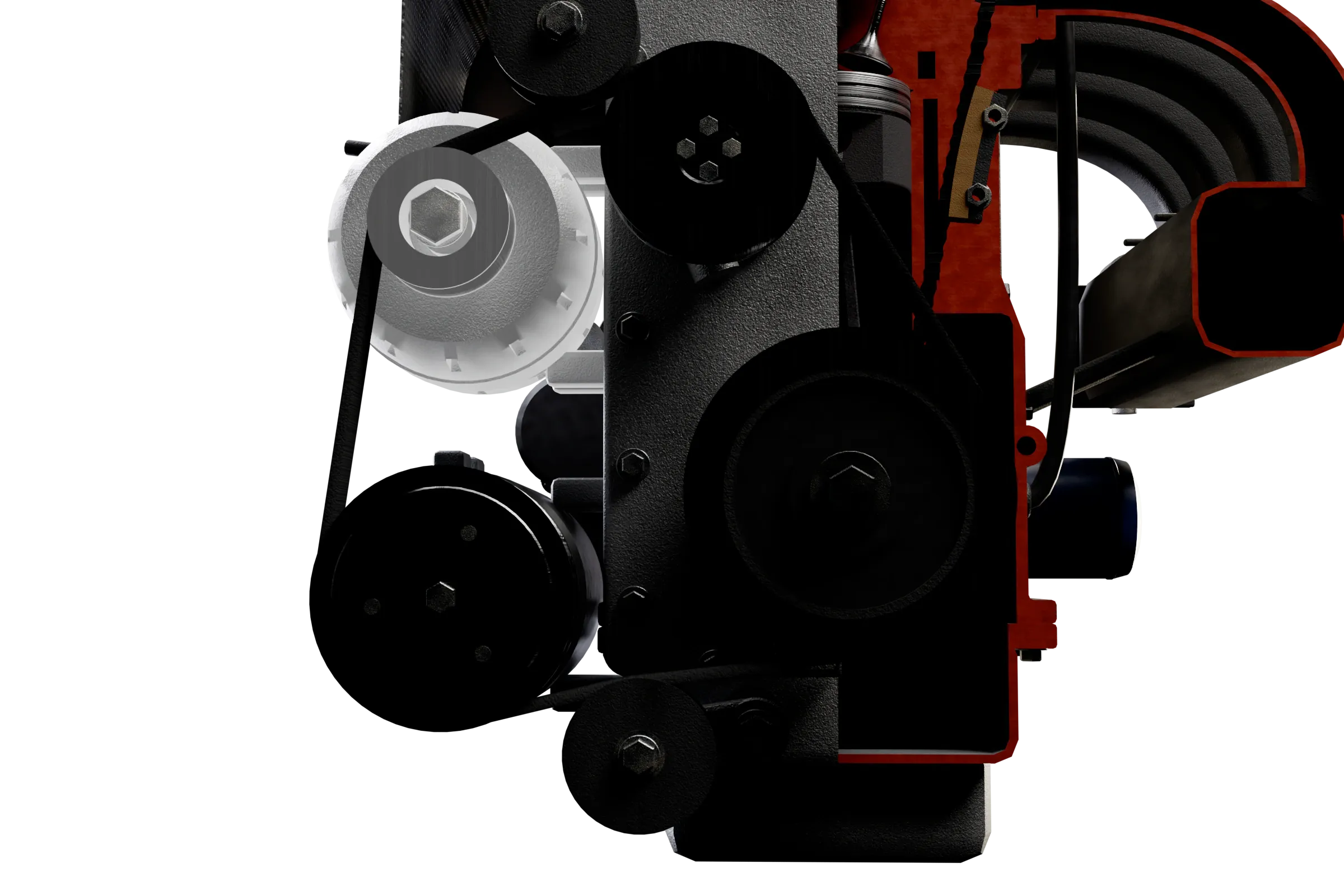
- Alternator
- Serpentine belt UK: Accessory belt
- Belt tensioner
- Harmonic balancer UK: Crankshaft pulley / torsional damper
How does an alternator work?
Inside, a spinning rotor carries an electromagnet, fed with a small current through brushes and slip rings, and it turns inside a ring of fixed copper windings called the stator. The moving magnetic field makes alternating current in the stator, and a set of diodes, the rectifier, turns it into the direct current the car runs on.
A voltage regulator holds the output at about 14 volts, a little above the battery's own, by varying the current to the rotor: more when the headlights, the heater fan and the rear defroster are on, less once the battery is full. On many newer cars the engine computer controls it, charging harder as the car slows down and easing off when it accelerates.
In the app's engine the serpentine belt from the harmonic balancer on the front of the crankshaft turns the alternator, the same belt that drives the water pump and the A/C compressor. Its small pulley spins it several times faster than the engine, so it charges even at idle.
What are the symptoms of a bad alternator?
- The battery warning light comes on. A red battery-shaped light while you drive means the system is not charging, and the car is running on what is left in the battery.
- Dim or flickering lights. Headlights and dash lights that dim at idle and brighten as the engine speeds up, or flicker, point to a falling charging voltage.
- Electrical faults. Slow power windows, a radio that resets and warning lights that come and go are all signs of a sagging voltage.
- A battery that keeps going flat. A battery that dies again after a charge, or soon after it was replaced, is often one the alternator is not recharging.
- A whine or growl from the belt area. A worn bearing growls, and failing diodes can whine with engine speed, a whine that often comes through the radio too.
- A smell of hot rubber or wiring. A belt slipping on a seized alternator pulley smells of hot rubber, and an overheating alternator smells of hot wiring.
Can you drive with a bad alternator?
Have it checked before you drive far
Only a short way, straight to a repair shop. With the alternator not charging, the car runs on its battery until the battery is flat, and then the engine stops, often without warning. Switch off what you can do without, such as the heater fan, the rear defroster and the radio, and avoid switching the engine off, since it may not restart. If the battery light comes on together with a climbing temperature gauge, the belt that drives both the alternator and the water pump may have snapped: pull over when it is safe and switch off, because the engine will overheat.
Is it the alternator or the battery?
A voltmeter answers it in a minute. With the engine off, a healthy, charged battery reads about 12.6 volts across its terminals. With the engine running, the reading should rise to about 13.5 to 14.5 volts as the alternator takes over. If it stays near the battery’s own voltage, or falls as you switch on the headlights, the alternator is not charging. If the voltage is right with the engine running but the battery still goes flat overnight, look at the battery itself or at something draining it. Most parts stores and repair shops can load-test both.
What makes an alternator fail?
Wear, mostly. The brushes wear down, the bearings dry out and the diodes fail with heat, usually after many years. Oil or coolant leaking onto it, a belt that is too tight and a deeply flat battery left for the alternator to recharge on its own all shorten its life. The battery itself is not part of the app’s engine, but the alternator, its pulley and the belt that turns it are: the four-stroke engine guide shows them on the front of the engine.
What does replacing an alternator involve?
- Disconnect the battery's negative cable first, so nothing can short while you work.
- Release the serpentine belt's tensioner and slip the belt off the alternator's pulley, noting the belt's route around the pulleys.
- Unplug the connector and undo the nut on the heavy charging cable.
- Unbolt the alternator from its bracket and lift it out, which on some engines means removing other parts first.
- Install the new alternator, reconnect its wiring and refit the belt along its route, letting the tensioner take up the slack.
- Reconnect the battery, start the engine and check the charging voltage at the battery and that the warning light stays out.
Tighten every nut and bolt to the torque spec in the manufacturer's service manual for your car.
On many engines a moderate home repair with hand tools; on some the alternator sits low down or behind other parts. Look at the belt and its tensioner while they are off, because a worn belt or a weak tensioner lets a new alternator slip and undercharge.
Questions people ask
How long does an alternator last?
Often 100,000 miles or more, and many last the life of the car. Short trips with heavy electrical loads, heat and oil or coolant leaking onto it all shorten its life.
Can a bad alternator drain the battery when the car is off?
Yes. A failed diode in the rectifier can let current leak back through the alternator while the car is parked, flattening the battery overnight. A shop can find it by measuring the current the car draws with everything switched off.
Will a car start with a bad alternator?
Often, if the battery still has charge, since the starter runs from the battery. It then runs until the battery is flat. A car that starts after a jump and dies a few minutes later points to the alternator.
Related
Parts nearby
- What does a water pump do in a car? A car's water pump circulates coolant through the engine block, the cylinder head and the radiator, carrying heat out of the engine.
- What does a crankshaft position sensor do? A crankshaft position sensor reads a toothed ring on the crankshaft and tells the engine computer how fast the engine is turning and exactly where each piston is.
- What does a throttle body do? A throttle body is the valve that controls how much air flows into the engine, and so how much power it makes.
- What do piston rings do? Piston rings are the split metal rings in grooves around each piston.
The whole system
- How does a four-stroke engine work? The four-stroke engine, part by part, with an interactive diagram.
