
What does a throttle body do?
A throttle body is the valve that controls how much air flows into the engine, and so how much power it makes. A round plate inside it, turned by a small motor on modern cars, opens as you press the gas pedal. A dirty throttle body gives a rough or surging idle, stalling and a hesitant pull away.
Also called electronic throttle body, throttle valve
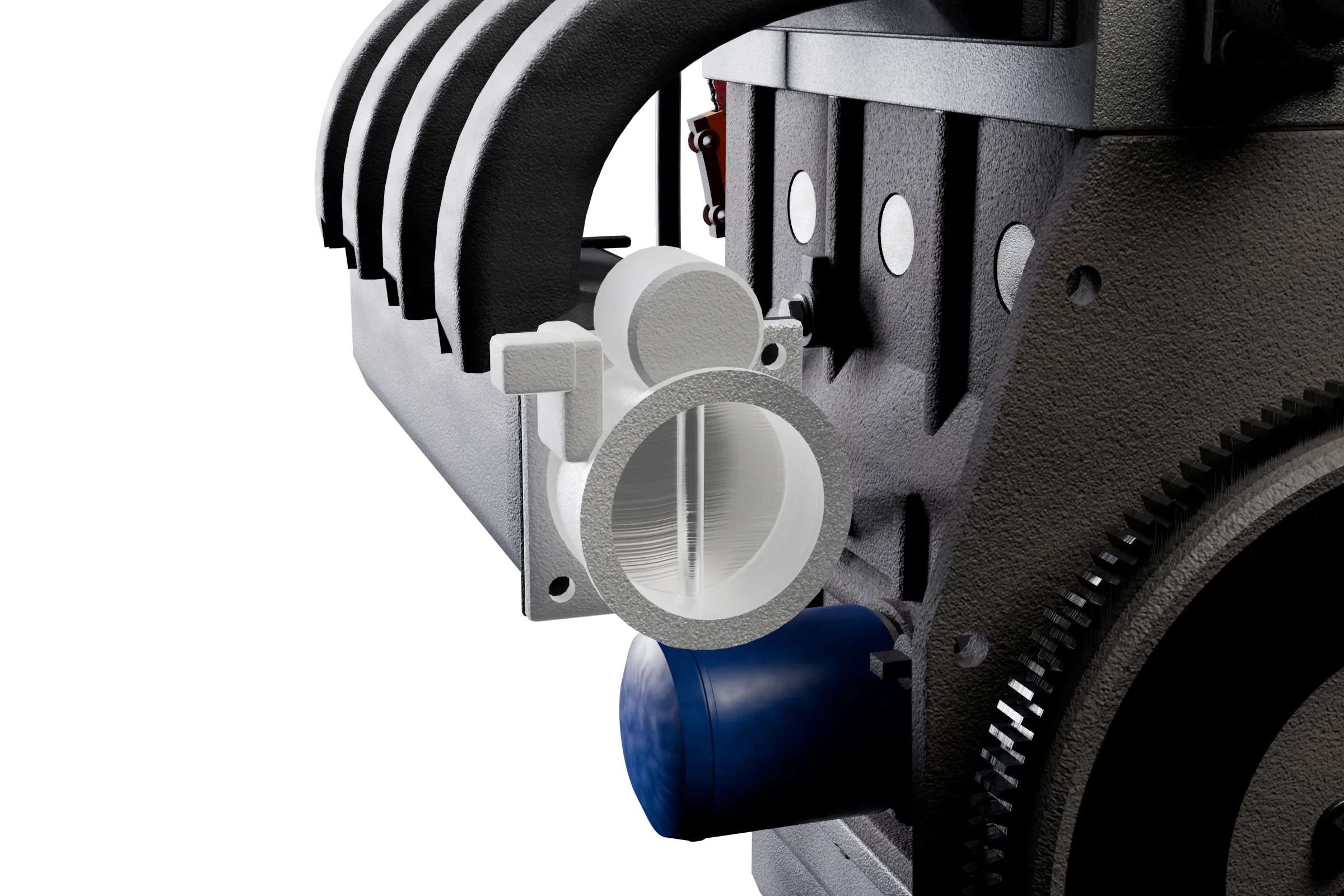
- Electronic throttle body
- Throttle plate
- Intake manifold
How does a throttle body work?
It sits between the air filter and the intake manifold, where every bit of air the engine breathes has to pass. Inside is a round butterfly plate on a shaft. Closed, it nearly fills the bore; turned, it lets more air through, and the engine computer adds fuel to match. In the app's engine the plate sits at 7° at idle and turns until it lies flat in the airflow at full throttle.
On modern cars nothing connects the gas pedal to the plate. A sensor on the pedal tells the engine computer how far you have pressed it, and the computer drives a small electric motor on the throttle body to set the plate, checking its angle with two position sensors. That lets the computer smooth your inputs, hold the idle steady when the A/C or the alternator adds load, and run the cruise control and traction control.
Older engines had a cable from the pedal to the plate and a separate idle air valve. Either way, the plate meters the air in the same way.
What are the symptoms of a dirty throttle body?
- A rough, low or surging idle. Carbon around the edge of the plate chokes the small gap the idle air passes through, so the idle hunts up and down or drops low.
- Stalling when you stop or turn on the A/C. With too little air getting past the dirty plate, the engine cannot hold its idle when the load rises, and it can die as you come to a stop.
- A hesitant or jerky pull away. The plate can stick for a moment before it moves, so the car hesitates and then lurches as you press the pedal.
- The check engine light and limp mode. If the two position sensors disagree or the motor cannot set the plate, the computer stores a code and limits the throttle to a small opening.
- Worse gas mileage. An engine that struggles to idle steadily wastes fuel, and the computer opens the plate a little further to make up for the dirt.
Can you drive with a bad throttle body?
Have it checked before you drive far
A dirty one, yes, for a while, though the idle may be rough and it is worth cleaning soon. A failing one is more serious: an electronic throttle that faults can drop into limp mode, which allows very little power, or stall the engine at a stop, which is risky when pulling out into traffic. If the car has gone into limp mode or stalls, have it checked before you drive far.
Why does a throttle body get dirty?
Because some of what the engine breathes out comes back through it. Crankcase fumes, a fine oil mist and soot pushed back through the intake when the engine shuts down all settle on the cool metal around the plate, where they bake into a hard black ring. At idle the plate is nearly shut, so the air only passes through a gap a fraction of an inch wide, and even a thin layer of carbon can choke it.
Where is the throttle body located?
At the entrance to the intake manifold, where the big duct from the air filter box connects. On most engines it sits at the front or the side of the engine, and its electric motor and connector are on one side of its housing. In the app’s engine it bolts to the intake manifold’s plenum. The four-stroke engine guide shows its place among the other parts in an exploded diagram.
What does cleaning or replacing a throttle body involve?
- With the engine off and cool, take off the air intake duct at the throttle body to see the plate.
- Look at the bore and the edge of the plate for the black ring of carbon that builds up there.
- With the ignition off, open the plate gently by hand, never by forcing the motor's gears, and wipe the carbon off the bore and both sides of the plate with a throttle body cleaner on a lint-free cloth.
- Let the cleaner evaporate, refit the duct and start the engine; it may idle unevenly at first.
- Many cars need an idle relearn after a cleaning, either by a set procedure in the owner's manual or with a scan tool.
- A throttle body that still faults, with codes for its motor or sensors, is replaced as a unit, then relearned in the same way.
Tighten every nut and bolt to the torque spec in the manufacturer's service manual for your car.
Cleaning is a short, simple task on most engines. Spraying cleaner into the bore with the engine running, or cleaning the motor and sensors, can damage an electronic throttle body; follow the cleaner's and the automaker's instructions.
Questions people ask
How often should a throttle body be cleaned?
There is no fixed interval on most cars. Many owners clean it when the idle turns rough, or every few years when the air intake is off for another reason. Engines that send crankcase fumes into the intake ahead of the throttle collect carbon fastest.
Does cleaning the throttle body improve performance?
It restores what the dirt took away: a steady idle, a clean pull away and the idle air the computer expects. On an engine that ran well already, it makes little difference.
What is limp mode?
A fallback the engine computer uses when it finds a fault it cannot trust, such as two throttle sensors that disagree. It limits the engine to a small throttle opening and low power, so the car can still be moved off the road and to a repair shop.
Related
Parts nearby
- What does a crankshaft position sensor do? A crankshaft position sensor reads a toothed ring on the crankshaft and tells the engine computer how fast the engine is turning and exactly where each piston is.
- What does an ignition coil do? An ignition coil turns the car's 12 volts into the tens of thousands of volts a spark plug needs to fire.
- What do piston rings do? Piston rings are the split metal rings in grooves around each piston.
- What do spark plugs do? Spark plugs light the compressed fuel and air in each cylinder of a gasoline engine.
The whole system
- How does a four-stroke engine work? The four-stroke engine, part by part, with an interactive diagram.
