
What does an ignition coil do?
An ignition coil turns the car's 12 volts into the tens of thousands of volts a spark plug needs to fire. Most modern engines have one coil on top of each plug. A bad ignition coil makes its cylinder misfire: the engine shakes, loses power, runs rough at idle and turns on the check engine light, which flashes if the misfire is bad.
Also called coil pack, coil-on-plug
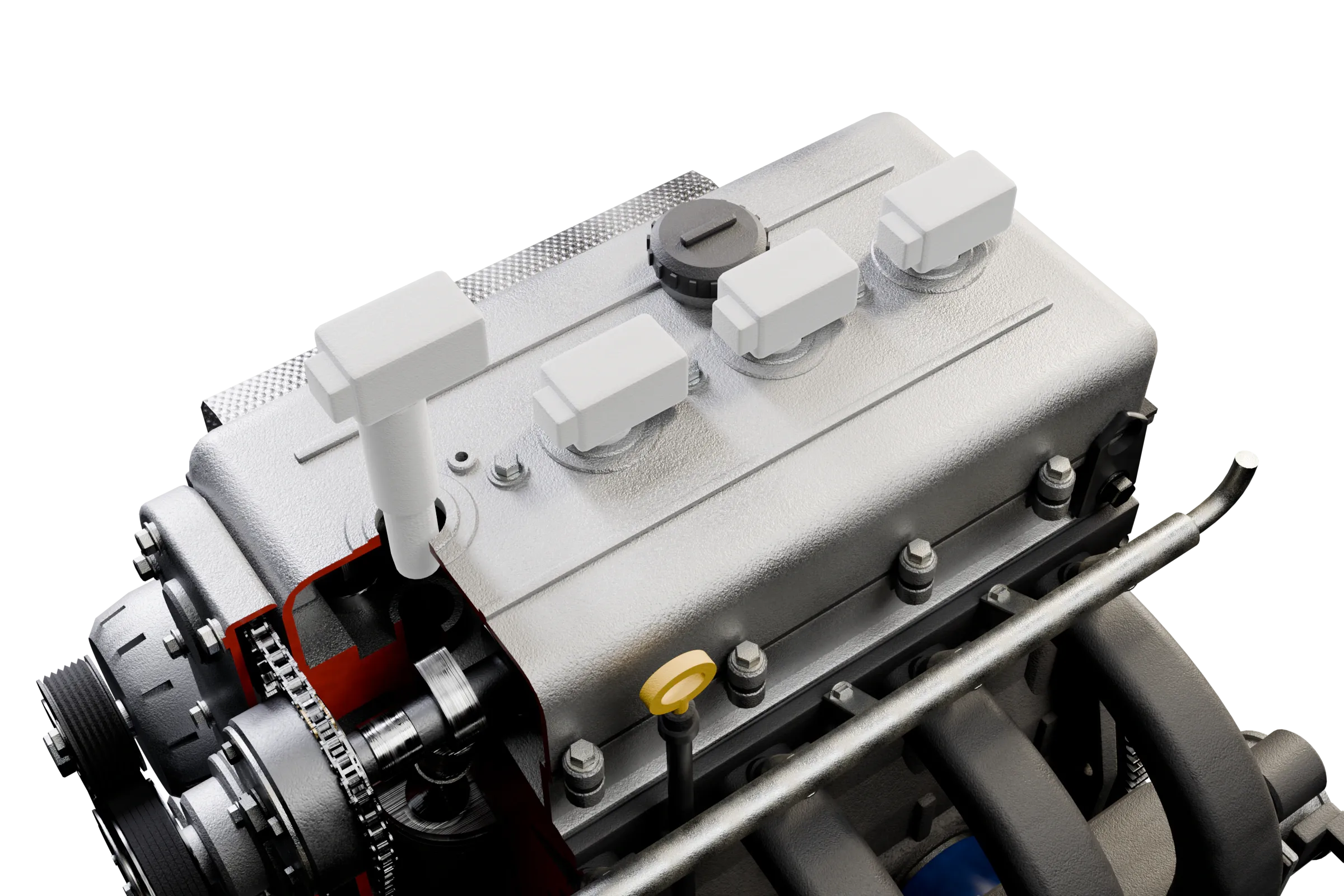
- Ignition coil
- Spark plug
- Valve cover UK: Cam cover
How does an ignition coil work?
A coil is a transformer. Inside it, a primary winding of a few hundred turns of thick wire sits around an iron core, wrapped by a secondary winding of many thousands of turns of fine wire. The engine computer switches current through the primary to build up a magnetic field, then cuts it off at the moment the spark is due. The field collapses through both windings at once, and the secondary, with so many more turns, delivers a pulse of tens of thousands of volts to the plug.
In the app's engine each cylinder has its own coil, a coil-on-plug design: the coil sits in a tube in the valve cover, and its rubber boot pushes straight onto the top of the spark plug. With no plug wires to leak or wear out, each coil only has to fire once every two turns of the engine, and the computer can time each cylinder's spark on its own.
Older engines used one coil and a distributor, then coil packs that fire two plugs at a time through plug wires. The idea is the same in each.
What are the symptoms of a bad ignition coil?
- A misfire and the check engine light. A weak coil cannot fire its plug, so one cylinder drops out. The light comes on with a misfire code naming the cylinder, and it flashes when the misfire is bad. Why is my check engine light flashing?
- Shaking or rough idle. With one cylinder missing, the engine shakes at idle and the shake comes through the seats and the steering wheel.
- Hesitation and lost power when accelerating. A coil that is failing often works at idle but cannot make a big enough spark under load, so the engine stumbles when you ask for power. Why is my car shaking when I accelerate?
- Hard starting, worst when damp. Cracks in a coil's housing or boot let the spark leak to the engine instead of jumping the plug's gap, most of all in wet weather.
- Worse gas mileage. Fuel that does not burn in a misfiring cylinder is wasted, and it heats the catalytic converter as it burns there instead.
Can you drive with a bad ignition coil?
Have it checked before you drive far
Only gently, and only as far as a repair shop, while the check engine light stays steady. A misfiring cylinder sends unburned fuel into the exhaust, where it burns inside the catalytic converter and can overheat and ruin it. If the check engine light flashes, the misfire is bad enough to do that quickly: pull over when it is safe, switch off and have the car checked before you drive on.
Where is the ignition coil located?
On top of the engine, in most cars built in the last twenty years. With a coil on each plug, as in the app’s engine, each one sits in a tube in the valve cover, straight above its spark plug, with a connector on top and a bolt to hold it. On engines with a coil pack, the pack is bolted to the engine and plug wires run from it to each plug.
Is it the ignition coil or the spark plug?
Both cause the same misfire, so the swap test in the questions below is the quickest way to tell. The spark plug shows wear when it comes out: a worn, rounded center electrode, a wide gap, or a tip coated in oil or soot. A coil may show cracks in its boot, or a thin black line of carbon where the spark has been tracking down its side to the engine. The spark plugs page covers the plug’s side of it, and the four-stroke engine guide shows how the engine times each spark.
What does replacing an ignition coil involve?
- Read the fault codes to find the misfiring cylinder, then switch the ignition off.
- Unplug that coil's connector and take out the bolt that holds it.
- Twist the coil gently and lift it straight out of its tube, looking at the boot for cracks, carbon tracks or oil.
- Look at the spark plug while the coil is out; if the plugs are due, change them at the same time.
- Push the new coil down until its boot clicks onto the plug, then bolt it down and plug it in.
- Clear the codes and start the engine: it should idle smoothly, with no misfire.
Tighten every nut and bolt to the torque spec in the manufacturer's service manual for your car.
On most four-cylinder engines with a coil on each plug, a coil can be changed in a few minutes with basic hand tools. On some V6 and V8 engines the rear coils sit under the intake manifold, which takes much longer.
Questions people ask
How do you find which ignition coil is bad?
Read the codes: a misfire code such as P0302 names cylinder 2. Then swap that coil with one from another cylinder and clear the codes. If the misfire moves to the other cylinder, the coil is at fault; if it stays put, look at the spark plug and the injector.
Should you replace all the ignition coils at once?
Not usually. Coils fail one at a time, and most mechanics replace only the one that has failed. On a high-mileage engine where the coils are the same age and a second one has started to go, some owners change the set.
Can a bad spark plug damage an ignition coil?
Yes. A worn plug with a wide gap needs a higher voltage to fire, so the coil works harder every time, and the extra strain and heat can crack its insulation. That is one reason to change worn plugs on time.
What causes ignition coils to fail?
Heat and age, mostly, since they sit on top of a hot engine. Oil leaking into the plug tubes from a failing valve cover gasket soaks the boots, and worn spark plugs make the coils work harder.
Related
Symptoms
- Why is my check engine light flashing? A flashing check engine light means the engine is misfiring badly enough to damage the catalytic converter: fuel that does not burn in a cylinder reaches it and burns inside.
- Why is my car shaking when I accelerate? A car that shakes when you accelerate, and smooths out when you ease off the gas, usually has a worn inner CV joint or worn engine and transmission mounts.
Parts nearby
- What do spark plugs do? Spark plugs light the compressed fuel and air in each cylinder of a gasoline engine.
- What does a crankshaft position sensor do? A crankshaft position sensor reads a toothed ring on the crankshaft and tells the engine computer how fast the engine is turning and exactly where each piston is.
- What does a throttle body do? A throttle body is the valve that controls how much air flows into the engine, and so how much power it makes.
- What do piston rings do? Piston rings are the split metal rings in grooves around each piston.
The whole system
- How does a four-stroke engine work? The four-stroke engine, part by part, with an interactive diagram.
