
Why doesn't my steering wheel return to center?
After a turn, the front wheels' caster and the way the tires grip the road should pull the steering wheel back to center on their own. When it stays turned or comes back slowly, the usual causes are a binding strut mount, a stiff ball joint or tie rod end, caster out of spec or low tire pressure.
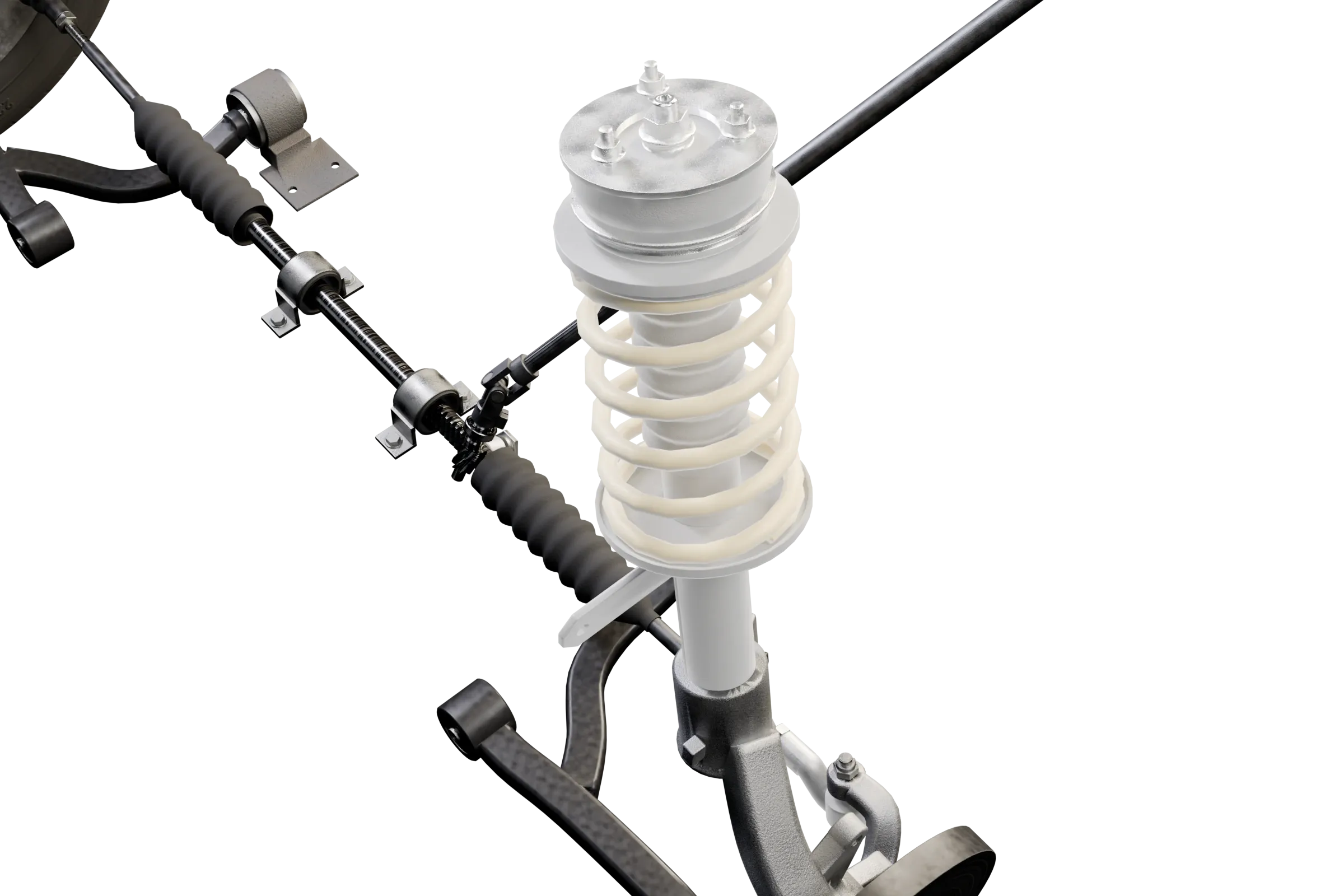
- Strut mount
- Strut and coil spring UK: Strut and spring
- Outer tie rod end UK: Track rod end
- Rack support yoke UK: Rack yoke
The likely causes, most common first
-
A binding strut mount bearing
Most likelyHow it shows The wheel comes back slowly or stays turned, often with a creak, a pop or a notchy feel as you steer at parking speed.
Check With the car parked and the engine running, turn the wheel slowly from lock to lock while a helper rests a hand on top of each strut tower: a bearing that binds pops or grates there.
The fix A new strut mount and bearing, then an alignment.
Have it checked soon
-
How it shows Heavy steering that does not unwind, sometimes with a squeak or creak, often on an older car or after a torn boot let water in.
Check With the front safely raised and the wheels off the ground, turn each wheel by hand from lock to lock. A joint that resists or grinds is stiff.
The fix The stiff joint replaced, then an alignment.
Have it checked soon
-
How it shows A wheel that returns weakly, or a car that wanders, often after hitting a curb or a deep pothole.
Check Have the alignment checked, including caster, and the control arms and their bushings inspected for damage.
The fix Bent or worn parts replaced, then the alignment set.
Have it checked soon
-
Low tire pressure
CommonHow it shows A slow return and heavier steering all round, with the front tires looking low.
Check Set all four tires to the pressures on the label on the driver's door jamb, measured cold.
The fix The pressures corrected, and a check for a slow leak.
Fix it soon
-
A sticking steering rack
Less likelyHow it shows The wheel is reluctant to turn and to come back at one point in its travel, or feels notchy through the center.
Check Have the rack checked with the tie rods disconnected, so its own movement can be felt.
The fix A new or remanufactured rack.
Have it checked soon
-
An electric power steering fault
Less likelyHow it shows The wheel does not return with the engine running but moves freely with it off, sometimes with the power steering light on.
Check Have the fault codes read. Many systems help the wheel back to center, and a sensor fault upsets that.
The fix The fault repaired, then the steering angle recalibrated.
Have it checked soon
How to narrow it down
- Check all four tire pressures cold against the label on the driver's door jamb.
- In an empty parking lot, make a slow turn and loosen your grip as you straighten. Note whether the wheel returns, how fast, and whether one direction is worse.
- With the car parked and the engine running, turn the wheel slowly from lock to lock and listen at each strut tower for a pop, a creak or a grind.
- Have the alignment checked, including caster, if the car has hit a curb or a deep pothole.
Is it safe to drive if the steering wheel won't return to center?
Have it checked before you drive far
Have it checked before you drive far. A wheel that does not unwind has to be steered back by hand after every turn, which is tiring and easy to get wrong, and a binding mount or joint usually gets worse. If the steering suddenly feels stiff or locks, or a joint grinds, don't drive it.
Why does it return to center one way but not the other?
Caster on each side pulls its own wheel back toward straight ahead, so the two sides share the work. If the wheel unwinds after a left turn but not after a right one, look at that side first: its caster may be lower after a curb strike, or a part on that side may be binding, such as its strut mount, ball joint or tie rod end. Turning from lock to lock with a helper at each strut tower usually finds a binding mount, and an alignment printout shows a caster difference between the sides. A difference that large often makes the car pull a little too.
Questions people ask
Why won't my steering wheel return to center after an alignment?
Usually because caster was set too low or unevenly from side to side, or a part replaced during the work is binding. A tie rod end or ball joint tightened with the steering turned can also hold it. Take it back to the shop that did it and ask for the alignment printout.
Is it normal for the steering wheel to return slowly at low speed?
At walking pace, yes, on many cars, because the pull back to center builds with speed. At city speeds the wheel should unwind by itself after a turn; if it does not, something is binding.
Can a bad strut mount cause steering problems?
Yes. The strut mount carries a bearing that lets the strut turn as you steer. When it binds, the steering feels notchy, may creak or pop, and does not return to center well.
Related
The parts
- What does a ball joint do? A ball joint is the ball-and-socket joint that connects a suspension arm to the wheel's steering knuckle.
- What is a control arm? A control arm is a hinged suspension link between the car's subframe or body and the wheel.
- What does a steering rack do? A steering rack is a toothed steel bar that slides sideways in a housing across the front of the car.
- What does a power steering motor do? A power steering motor is the electric motor that helps you turn the steering wheel on cars with electric power steering.
Similar symptoms
- Why is my steering wheel hard to turn? A steering wheel that is hard to turn usually means the power steering assist has failed or been cut back.
- Why is my steering wheel off center? A steering wheel that sits off center while the car drives straight usually means the front toe is out of adjustment, or the tie rods were set unevenly at the last alignment.
- Why is there play in my steering wheel? Play in the steering wheel, where it turns a little before the wheels respond, comes from wear somewhere between the wheel and the tires: most often the tie rod ends, then the inner tie rods, the universal joints on the intermediate shaft, a worn rack or loose rack mounts.
- Why is my power steering light on? On most modern cars the power steering light, often a steering wheel with an exclamation point, means the electric power steering has found a fault and may have reduced or switched off its assist.
