
Brakes · Floating disc caliper
Why is my ABS light on?
An ABS light on the dash means the ABS unit has found a fault and switched anti-lock braking off. The normal brakes still work. The usual cause is a failed wheel speed sensor or its wiring, then a damaged tone ring or a worn wheel bearing. If the red brake warning light is on too, don't drive the car.
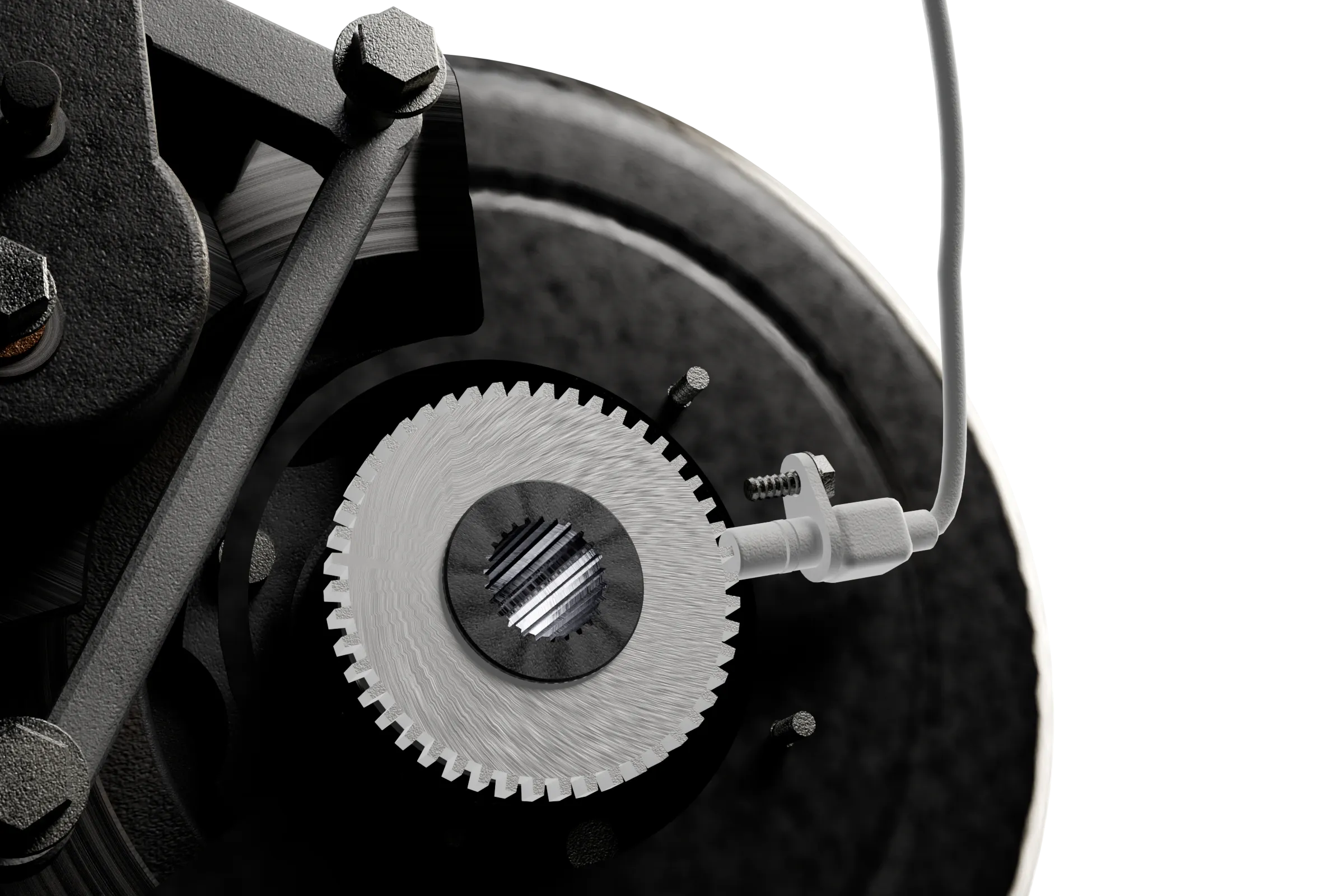
- ABS wheel-speed sensor
- ABS tone ring
- Wheel bearing
- Wheel hub
The likely causes, most common first
-
A failed wheel speed sensor or its wiring
Most likelyHow it shows The ABS light stays on, usually with the traction control light, or comes and goes over bumps and in the wet.
Check Have the ABS codes read: the code usually names the wheel. Look along that sensor's cable for cracks and at its connector for corrosion.
Have it checked soon
-
A damaged or rusty tone ring
CommonHow it shows The same light, sometimes with ABS pulsing the pedal in a gentle stop, because a cracked ring or a missing tooth drops the signal once a turn.
Check With the wheel off, look at the toothed ring beside the sensor tip, on the hub or the outer CV joint, for cracks, missing teeth and packed rust.
Have it checked soon
-
A worn wheel bearing
CommonHow it shows The light comes with a hum or growl from one wheel that rises with road speed: play in the bearing changes the sensor's gap.
Check With the wheel safely raised, rock it top to bottom for play and spin it by hand for roughness.
Have it checked soon
-
Low brake fluid
Less likelyHow it shows On some cars a low fluid level lights the ABS light along with the red brake warning light.
Check With the car level, look at the reservoir. Below MIN means a leak or very worn pads: have it checked before you drive.
Don't drive it
-
An ABS unit fault
Less likelyHow it shows The light stays on while every wheel sensor reads correctly, sometimes after the car has stood unused for months.
Check A scan tool reads the unit's own codes for its module, pump and valves. Some units are repaired; others are replaced and bled with a scan tool.
Have it checked soon
-
A blown fuse or low battery voltage
Less likelyHow it shows The ABS light, often with other warnings, after a jump start or with a failing battery, sometimes going out once the battery is charged.
Check Check the ABS fuses named in the owner's manual, and have the battery and the charging voltage tested.
Fix it soon
-
Tires of different sizes
Less likelyHow it shows The light after a new tire or the spare went on: a wheel of a different size turns at a different speed, and the unit reads that as a fault.
Check Check that all four tires are the same size and evenly worn.
Fix it soon
How to narrow it down
- Look at the dash. The amber ABS light alone means ABS is off; the red brake warning light as well means the brakes themselves need checking first.
- With the car on level ground, check the brake fluid against the reservoir's MIN mark.
- Restart the engine and drive off slowly. The light comes on briefly at every start as a bulb check, and a fault that is still there brings it back once the car moves.
- Have the codes read with a scan tool that talks to the ABS unit, which many basic engine code readers cannot. The code usually names the wheel.
- At that wheel, look at the sensor and its cable, the tone ring and the bearing, and check that all four tires match.
Is it safe to drive with the ABS light on?
Have it checked before you drive far
Usually, carefully, as far as a repair shop, if the ABS light is the only one on. The normal brakes work as they always did, but with ABS off, and usually traction and stability control too, the wheels can lock in a hard stop or on a slippery road, and a locked front wheel cannot steer the car. Leave more room and brake progressively. If the red brake warning light is on as well, don't drive it: the fluid may be low, or the system that shares braking between the front and rear wheels may be off too.
What does the ABS light mean for braking?
Less than it might seem. The brakes themselves are hydraulic: the pedal pushes fluid from the master cylinder to every caliper, with or without ABS. The ABS unit sits in the lines between them and only steps in when a wheel starts to lock, easing and reapplying that wheel’s brake until it turns again.
For that it reads a sensor at every hub. In the app’s brake model the sensor sits 0.8 mm from a 48-tooth ring on the hub, and each tooth that passes makes one pulse. When a signal goes missing or makes no sense, the unit cannot tell a locking wheel from a faulty sensor, so it switches ABS off and lights the warning. The car then stops like one built without ABS. The brakes guide shows how the unit spots a wheel about to lock.
How is the ABS light different from the brake warning light?
By color and by what it watches. The ABS light is amber and usually reads ABS. The brake warning light is red and reads BRAKE or shows an exclamation mark in a circle. It comes on when the parking brake is set, when the fluid is low and, on many cars, when the system that shares braking between the front and rear wheels has a fault. The amber light alone means the brakes still work without ABS. If the red one is on too, treat it as a brake fault and have the car checked before you drive on.
Why are the ABS and traction control lights on together?
Because they read the same wheel speed sensors. Traction control watches for a driven wheel turning faster than the others, and stability control uses the same signals to judge how the car is turning. When one sensor fails, the ABS unit switches them off along with ABS, so a single fault can light several warnings at once, and fixing it clears them together.
Why did the ABS light come on after changing the brakes?
Usually because something at the wheel was disturbed during the work: a sensor cable pulled or pinched as the caliper or the hub came off, a connector left unplugged, a sensor knocked out of place or caked in brake dust, or a tone ring cracked while a hub or a CV axle was handled. Start with the sensor at each wheel that was worked on. If the pedal also feels soft afterward, air may have reached the ABS unit while the brakes were bled, and on some cars only a scan tool that cycles the unit’s valves will purge it.
Questions people ask
What does ABS stand for?
Anti-lock braking system. In a hard stop it keeps the wheels from locking by easing and reapplying the brake on any wheel that is about to lock, many times a second, so the car can still be steered while it slows.
Is the ABS light the same as the check engine light?
No. The check engine light reports faults in the engine and emissions systems. The ABS light comes from the ABS unit, which keeps its own fault codes, so a basic reader that only talks to the engine computer often finds nothing.
Why does the ABS light come on and off while driving?
Because the signal it depends on comes and goes. A sensor cable cracked where it flexes with the suspension, a connector that loses contact in the wet or a sensor tip caked in dirt can each drop out for a moment, and the ABS unit switches ABS off every time it sees that. The stored code still names the wheel.
Related
The parts
- What does an ABS sensor do? An ABS sensor, or wheel speed sensor, measures how fast its wheel is turning by reading a toothed or magnetic ring that turns with the hub.
- What does a wheel bearing do? A wheel bearing lets the wheel spin freely while carrying the car's weight and the cornering and braking loads.
- What does brake fluid do? Brake fluid carries the push from the brake pedal to the calipers.
Similar symptoms
- Why is my car humming when I drive? A humming noise that rises with road speed is usually a worn wheel bearing, especially if it changes as you go around a curve.
- What causes a spongy brake pedal? A spongy or soft brake pedal usually means air in the brake fluid, which compresses where fluid does not.
- What causes a grinding noise when braking? A grinding noise when you brake usually means the brake pads have worn through their friction material, so their steel backing plates are scraping the brake rotors.
- Why are my brakes squeaking? Brakes squeak when the pads and rotor vibrate at a high pitch as they rub.
Explained
- Disc vs drum brakes: what's the difference? A disc brake squeezes pads against a rotor that turns with the wheel; a drum brake pushes shoes outward against the inside of a drum.
