
Brakes · Floating disc caliper
Why does my car click when I brake?
A single click as you brake, often the first stop after you change direction, usually comes from the pads shifting in the caliper bracket: missing or worn abutment clips let them move until they hit the bracket. Loose caliper bolts, worn slide pin bushings and a loose wheel are less common but more urgent. Have it checked soon.
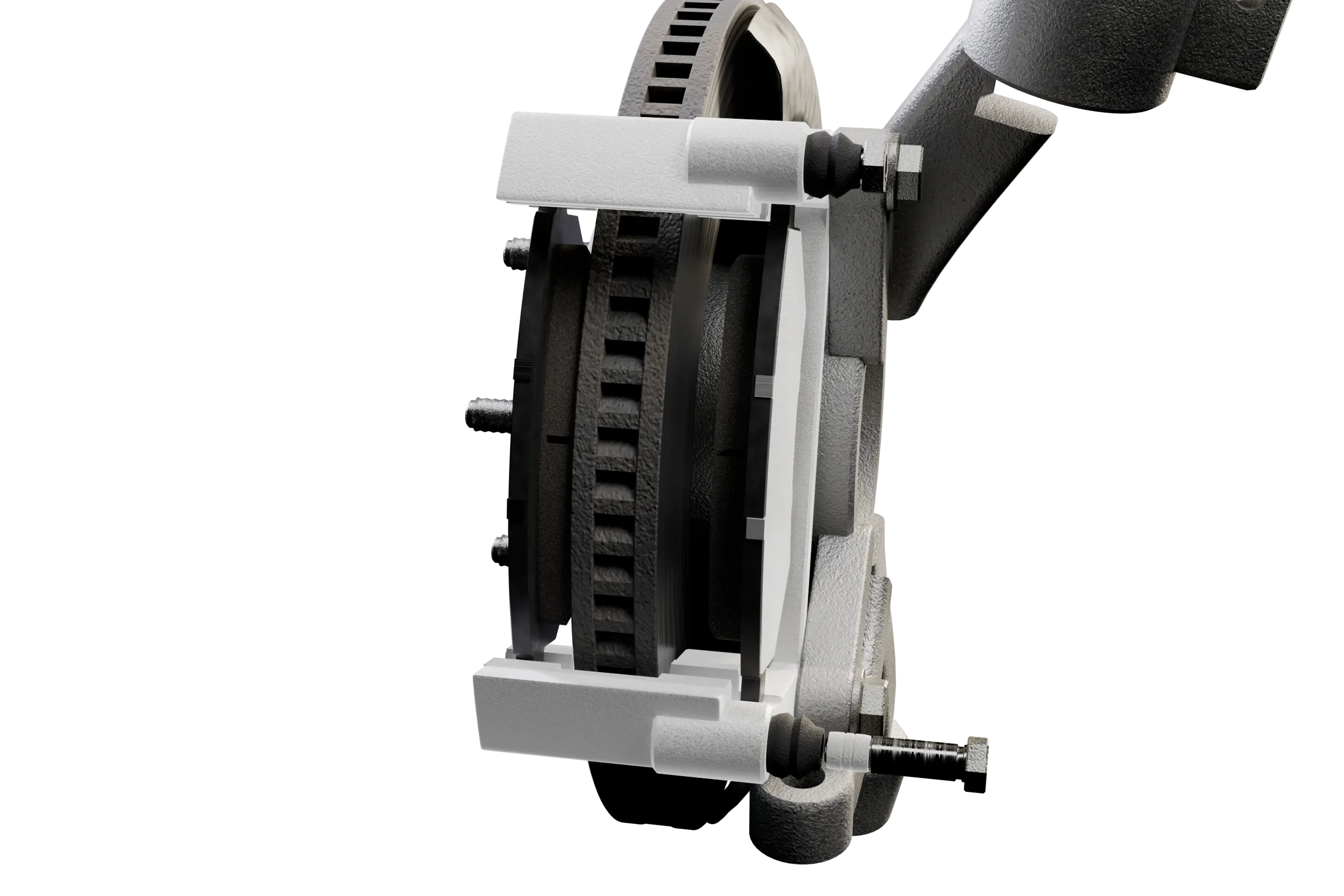
- Pad abutment clip, upper
- Pad abutment clip, lower
- Caliper bracket
- Anti-squeal shim, inner
- Slide pin bushing UK: Guide pin bush
The likely causes, most common first
-
Pads shifting in the caliper bracket
Most likelyHow it shows One click from the front as you first brake after reversing, or on the first stop after changing direction.
Check With the wheel off, look for the thin metal abutment clips where each pad sits in the bracket. Missing, rusty or loose clips let the pads move.
The fix New abutment clips, with the bracket cleaned of rust, usually fitted with new pads.
Fix it soon
-
Missing anti-rattle springs or shims
CommonHow it shows A click or light rattle under braking that started after a pad change.
Check Compare the hardware on the brake with the parts that came with the pads. A spring or shim left out lets a pad rattle.
The fix The missing hardware fitted.
Fix it soon
-
Worn slide pin bushings
CommonHow it shows A clunk or click from one wheel as you brake and release, sometimes with uneven pad wear.
Check Grip the caliper and try to rock it on its pins. A knock or free play means the bushings are worn.
The fix New pins and bushings, greased, with new boots.
Have it checked soon
-
A loose caliper or caliper bracket bolt
Less likelyHow it shows A clunk under braking that grows louder, sometimes with a scrape or a pull.
Check Have the caliper and bracket bolts checked for tightness right away.
The fix The bolts tightened to the manufacturer's spec, with new ones where the spec calls for them.
Don't drive it
-
Loose lug nuts
Less likelyHow it shows A click or clunk from one wheel at low speed and under braking, often after a tire change.
Check Check that every lug nut on that wheel is tight.
The fix The nuts tightened in a star pattern to the spec in the owner's manual.
Don't drive it
-
A worn CV joint or suspension joint
Less likelyHow it shows Clicking that also comes when turning or accelerating, not only when braking.
Check Note whether it clicks on tight turns or over bumps too. If it does, it is usually not the brakes.
The fix The worn joint replaced.
Have it checked soon
How to narrow it down
- Note when it clicks: on the first stop after reversing, on every stop, or also on turns.
- With the wheel off, look at the pads' clips, springs and shims for missing or rusty parts.
- Grip each caliper and try to rock it. It should not knock.
- If a wheel was off recently, check that its lug nuts are tight.
Is it safe to drive with a clicking noise when braking?
Have it checked before you drive far
A single click as the pads settle is not dangerous by itself, but have it checked before you drive far, because the same click can come from a loose caliper bolt or a loose wheel, and both can fail. If the click turns into a clunk, comes with a pull or a scrape, or started right after brake or tire work, stop and check before going on.
Why does it click only once?
Because the pad only moves once. Each pad sits in the caliper bracket with a small gap at its ends. When you brake, the turning rotor (disc) drags the pad toward one end of that gap, and it stays there until the car’s direction changes and the rotor drags it back the other way. Good abutment clips keep the gap small and the pad’s ends cushioned, so the move is silent. Rust under the clips, or a clip left out, lets the pad travel far enough to hit the bracket, and that knock is the click you hear on the first stop each way.
Questions people ask
Why do my brakes click when I brake in reverse?
Because the pads shift in the bracket when you change direction: braking going forward pushes them one way, braking in reverse the other. A worn or missing clip lets them move far enough to click. One click on the first stop each way is common, and new clips usually stop it.
Is a clicking noise normal after new brake pads?
A click on the first few stops after new pads can come from the pads settling, but it should stop. If it keeps clicking, a clip, spring or shim may be missing or fitted wrong, and the shop should look at it.
Can a click when braking come from the ABS?
Sometimes. ABS working makes a rapid pulsing or buzzing in the pedal on a slippery road, and many cars run a short self-test as they first pull away, which can buzz or click from the engine bay. A single click at every stop is the pads, not the ABS.
Related
The parts
- What do brake pads do? Brake pads are the friction blocks the caliper squeezes against the brake rotor, turning the car's movement into heat to slow it down.
- What does a brake caliper do? A brake caliper is the clamp at each disc brake. When you brake, fluid pressure pushes its piston out and the caliper squeezes the two pads against the brake rotor.
- What does a CV joint do? A CV (constant velocity) joint lets a shaft drive a wheel through an angle without the speed pulsing.
Similar symptoms
- Why are my brakes squeaking? Brakes squeak when the pads and rotor vibrate at a high pitch as they rub.
- What causes a grinding noise when braking? A grinding noise when you brake usually means the brake pads have worn through their friction material, so their steel backing plates are scraping the brake rotors.
- What causes uneven brake pad wear? Brake pads should wear evenly, inner and outer, side to side.
- Why does my car click when turning? A clicking noise when you turn, loudest at full lock as you start moving, is usually a worn outer CV joint on a front CV axle, most often after its boot has torn.
