
Brakes · Floating disc caliper
What causes uneven brake pad wear?
Brake pads should wear evenly, inner and outer, side to side. When they don't, a sticking caliper slide pin is the usual cause: the caliper can't center itself, so one pad stays pressed against the rotor (disc). A seizing piston, pads binding in a rusty bracket and a brake hose collapsing inside come next.
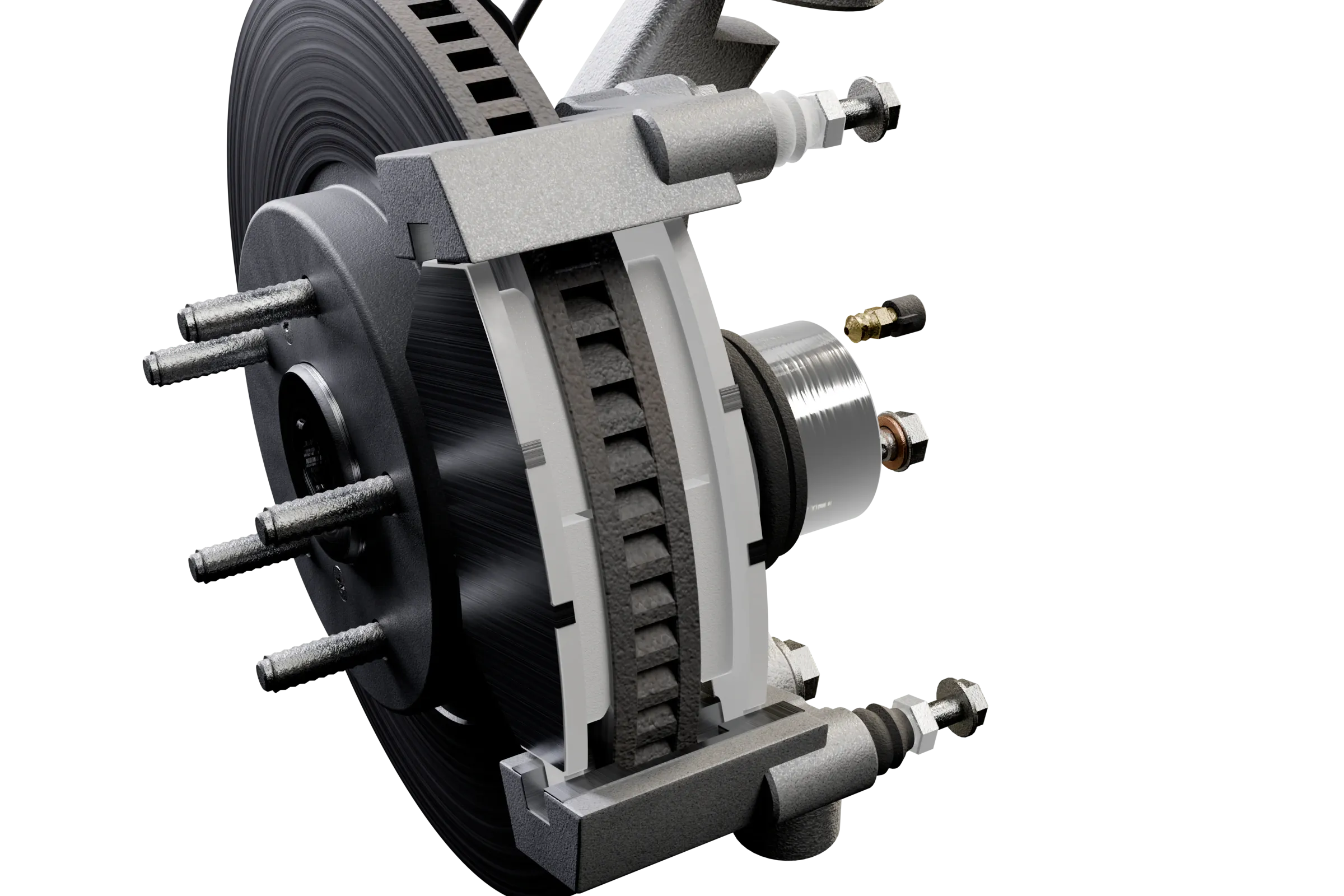
- Slide pin, upper UK: Guide pin, upper
- Slide pin, lower UK: Guide pin, lower
- Slide pin boot, upper UK: Guide pin boot, upper
- Caliper piston
- Brake pad, inner
- Brake pad, outer
The likely causes, most common first
-
Sticking caliper slide pins
Most likelyHow it shows The inner pad worn much thinner than the outer, often with a pull to one side when braking.
Check With the wheel off, compare the inner and outer pads, then push the caliper in and out on its pins: it should move with firm hand pressure. Torn pin boots let water in, and the pins rust.
The fix The pins cleaned and greased with high-temperature brake grease, with new boots or new pins, and new pads if they have worn unevenly.
Have it checked soon
-
A seizing caliper piston
CommonHow it shows One side's pads worn much faster than the other side's, a hot wheel after a drive and sometimes a burning smell.
Check After a short drive, hold a hand near each wheel without touching it. One much hotter than the others has a dragging brake.
The fix A new or rebuilt caliper, then a bleed.
Have it checked soon
-
How it shows Pads thicker at one end than the other, often with a squeal, or a click when you brake.
Check Look at each pad from the side. A wedge shape means the pad has been sticking at one end in the bracket.
The fix The bracket cleaned of rust, new abutment clips and new pads.
Fix it soon
-
A brake hose collapsing inside
Less likelyHow it shows One brake that releases slowly after you let off the pedal, so its pads wear faster and its wheel runs hot.
Check Have a shop check the hose. It can look fine outside while its inner lining traps pressure in the caliper.
The fix A new brake hose, then a bleed.
Have it checked soon
-
A scored or uneven rotor
Less likelyHow it shows Pads worn unevenly across their face, a pulsing pedal or grooves you can see on the rotor.
Check Look at both faces of the rotor for deep grooves, a lip at the outer edge or blue heat spots.
The fix New rotors and pads, replaced in pairs on the same axle.
Fix it soon
How to narrow it down
- With a wheel off, look at both pads on that brake. Compare inner with outer, then the same pads on the other side.
- Look at each pad from the side for a wedge shape.
- Look at the slide pin boots for tears, and check that the caliper moves on its pins.
- After a short drive, hold a hand near each wheel, without touching it, to find one that runs hotter.
Is it safe to drive with uneven brake pad wear?
Have it checked before you drive far
Have it checked before you drive far. Uneven wear means one pad is doing more of the work, so it runs hot and reaches its backing plate sooner, and a sticking caliper can drag, overheat and pull the car to one side. If you hear grinding, smell burning or the car pulls hard when braking, don't drive it.
Why does the caliper need to slide?
Most cars have floating calipers, with pistons on the inner side only. The piston pushes the inner pad onto the rotor, and the caliper body slides on its pins to pull the outer pad on from the other side, so both clamp equally. If the pins stick, the caliper can’t move freely: the outer pad clamps less, the inner pad does most of the work and stays lightly against the rotor after you let off the pedal. That is why the inner pad is usually the one that wears thin, and why clean, greased pins with whole boots belong in every pad change.
Questions people ask
Is it normal for inner brake pads to wear faster?
A little, on many cars. The inner pad is pushed straight onto the rotor by the piston, while the outer one is pulled on by the caliper sliding on its pins, so a small, even difference is normal. A big difference, or one side worse than the other, means the slide pins or the piston are sticking.
Should brake pads be replaced on both sides at once?
Yes. Pads are replaced as a set for both wheels on the same axle, so both sides brake equally. If one side wore much faster, the cause on that side is fixed at the same time, or the new pads wear unevenly again.
Can uneven pad wear make the car pull?
Yes. A caliper that sticks on one side brakes harder there, or drags all the time, and the car pulls toward that side when you brake. The pads on that side are usually the thinner ones.
Related
The parts
- What does a brake caliper do? A brake caliper is the clamp at each disc brake. When you brake, fluid pressure pushes its piston out and the caliper squeezes the two pads against the brake rotor.
- What do brake pads do? Brake pads are the friction blocks the caliper squeezes against the brake rotor, turning the car's movement into heat to slow it down.
- What do brake rotors do? Brake rotors are the iron discs that turn with the wheels. When you brake, the pads clamp both faces of the rotor and the friction slows the car.
Similar symptoms
- Why does my car pull to one side when braking? A car that pulls to one side when braking usually has a brake that grips harder on one side than the other.
- How do you know if a brake caliper is seized? A seized brake caliper cannot let go or cannot clamp. One stuck on keeps braking its wheel, so the car pulls to that side even off the brakes and the wheel runs hot with a burning smell.
- What causes a grinding noise when braking? A grinding noise when you brake usually means the brake pads have worn through their friction material, so their steel backing plates are scraping the brake rotors.
- Why does my car click when I brake? A single click as you brake, often the first stop after you change direction, usually comes from the pads shifting in the caliper bracket: missing or worn abutment clips let them move until they hit the bracket.
Explained
- Disc vs drum brakes: what's the difference? A disc brake squeezes pads against a rotor that turns with the wheel; a drum brake pushes shoes outward against the inside of a drum.
